
All on 4 Dental Implants in Antalya, Turkey
Tooth loss is a significant health issue that profoundly affects not only your ability to eat and speak but also your smile, self-confidence, and quality of life. Fortunately, modern dentistry now offers a permanent and reliable solution to this problem: All on 4 implant treatment.
Developed especially for those with multiple missing teeth, this innovative technique allows you to achieve fixed, natural-looking new teeth in just one day with only a few implants. At Aesthetic Dental Turkey, we offer this scientifically proven protocol with a high success rate, delivered by our expert surgeons and tailored to your individual needs, giving you a complete return to your life and smile.
What is All on 4?
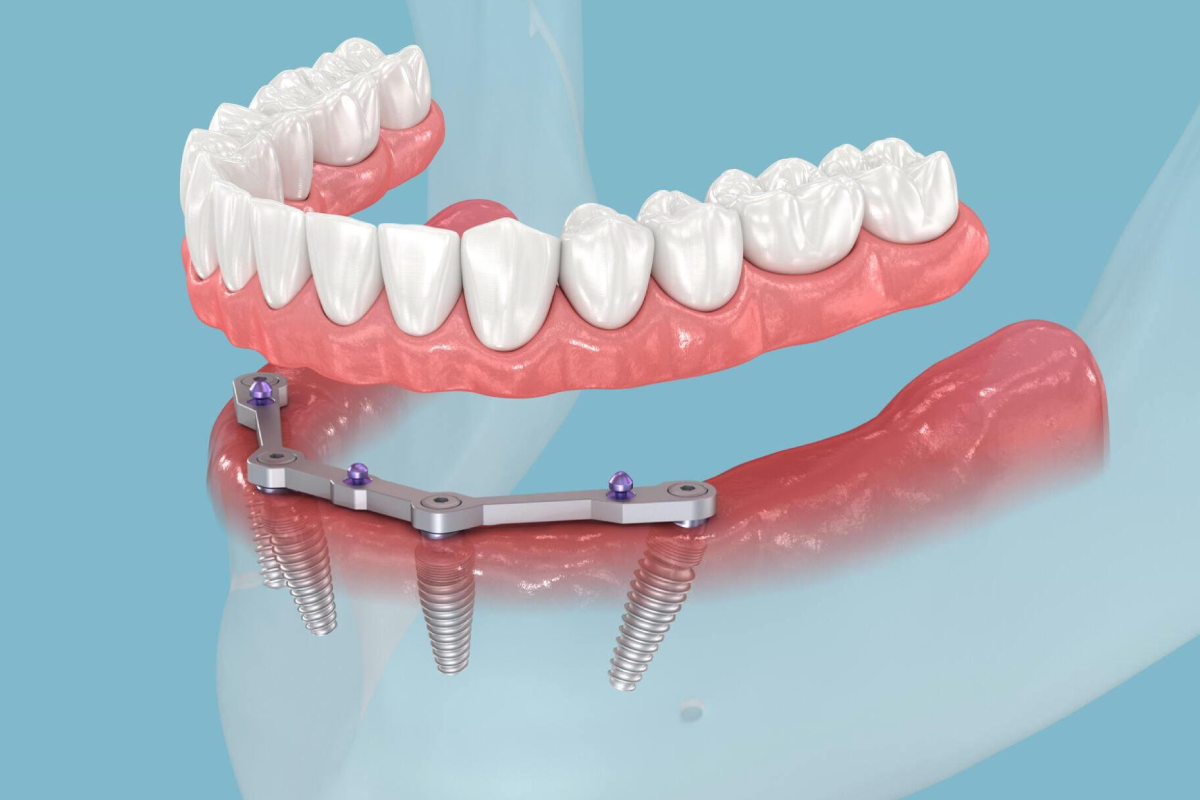
All on 4 is a modern and innovative implant treatment developed specifically for individuals who have lost all or nearly all of their teeth. Simply put, this method involves placing four implants (screws) into your upper or lower jaw, onto which a fixed, natural-looking denture is attached to replace all your teeth.
The biggest advantage of this technique is that it makes the best use of your existing jawbone, usually without the need for additional procedures such as “bone grafting.” As a result, you achieve a strong, secure, and beautiful smile, as if you had your own natural teeth.
What materials are used in All on 4 in Turkey?
Implants are made of titanium or titanium alloys; prosthetic teeth are made of durable materials such as acrylic, porcelain, or zirconium.
When is All on 4 an ideal solution?
This treatment method can be an excellent option, particularly in the following situations:
Complete or severe tooth loss:
It is an ideal permanent solution for individuals who have lost all their teeth or whose remaining teeth need to be extracted.
Those with bone deficiency (bone loss):
Many patients experiencing bone loss, particularly in the back regions, can be treated with All on 4 without the need for additional bone graft surgery.
Those bothered by removable dentures:
It is a fixed and secure alternative for those who use removable dentures and are dissatisfied with pain, loosening, inability to eat, or their smile.
For those seeking a quick and comfortable solution:
One of the most popular features of All on 4 is the ‘same-day teeth’ concept. Following the procedure, temporary yet fixed teeth are fitted on the same day. This means you won't be without teeth and can quickly resume your social life.
For those seeking less surgery and a more affordable option:
Compared to traditional full implant treatments, fewer implants are used, and additional bone surgery is usually not required. This both facilitates the recovery process and can make the total treatment cost more affordable.
Have Questions About All on 4?
Get a free personalized consultation from our implant specialists before booking your treatment.
Although All on 4 implant treatment is an excellent solution for many patients, it is not recommended in some cases.
Patients with insufficient bone support:
- Patients with excessive bone resorption (atrophy) and insufficient bone volume to support implants
- Cases where adequate stability cannot be achieved despite bone grafting (additional bone)
Those with uncontrolled systemic disease:
- Diabetes (HbA1c > 7) may slow down the healing process
- Osteoporosis—bone density may affect implant success
- Those with a weakened immune system (cancer patients, organ transplant patients)
- Uncontrolled heart disease or bleeding disorders
Individuals with poor oral hygiene:
- Those with advanced periodontal disease (gum recession)
- Smokers delay healing and reduce the chances of success
- Patients who do not practise regular dental care and do not attend doctor check-ups
Those with bruxism (Teeth grinding):
Severe clenching habits can cause excessive pressure on implants, leading to failure.
Those who are not psychologically prepared:
- Patients with unrealistic expectations
- Individuals who cannot comply with implant care
The number ‘4’ in the All on 4 technique comes from placing 4 titanium implants (small screws) in each jaw. These implants are positioned using a special strategy to make the most efficient use of your natural bone structure.
Placement for the Upper Jaw:
Front region: Two implants are placed vertically and straight towards the front, under the nose. This area generally has a thicker and stronger bone structure.
Posterior region: Two more implants are placed just in front of the sinus cavities in the upper part of the cheeks, at a special angle of approximately 45 degrees. This angled placement allows for maximum support from the existing bone without damaging the sinuses and usually eliminates the need for additional sinus surgery.
Placement for the Lower Jaw:
In the lower jaw, the sensitive nerve line under the tongue (alveolar nerve) is the most important structure that must be protected.
The two implants in the rear region are placed at a specific angle to protect this nerve. This minimizes the risk of nerve damage and provides strong support from the existing bone.
A special fixed, non-removable prosthesis (bridge) that looks like your natural teeth is placed over all four implants.
Although All on 4 can be applied without additional procedures in many patients with bone loss, a certain amount of healthy bone is still required for success. At Aesthetic Dental Turkey, we carefully examine each patient's 3D tomography images to create the safest and most successful surgical plan tailored to your bone structure. Our goal is to provide you with the most durable and comfortable smile using the least invasive method possible.
Generally required bone measurements:
Upper Jaw:
Front region: A minimum length of 10 mm and width of 4-5 mm (pencil thickness) is considered ideal.
Posterior region: There must be a minimum height of 5 mm below the sinus cavity to place the implant.
The bone tissue should not be too hard (like wood) or too soft (like sponge), but rather of medium hardness.
Lower Jaw:
Front region: A length of at least 12 mm and a width of 6 mm at the tip of the jaw is ideal.
Posterior region: A minimum bone height of 4 mm is required above the sensitive nerve to allow for implant placement.
If your bone structure is slightly below ideal measurements or there are deficiencies in certain areas, this does not mean that All on 4 treatment is not possible. Experienced surgeons can apply the following solutions in this case:
If the bone is thin or weak (lack of width): A minor bone augmentation procedure such as ‘bone expansion’ (autograft or bone powder application) can be performed. This prepares the necessary foundation for the implants to hold firmly.
If the bone is short or low (height deficiency): Special shorter implants can be used, or the angle of the implants can be further optimized to draw support from the stronger areas of the existing bone.
In cases of severe bone loss: In cases of severe resorption in the upper jaw, special alternative methods such as zygomatic (cheekbone) implants may be considered. This is based on the principle of attaching much longer implants to the cheekbone.
The implementation of the All on 4 treatment concept follows a specific protocol involving surgical and prosthetic procedures, carried out according to a precise plan. This approach uses only four implants for full arch restoration.
Treatment approach:
- Traditional surgery: This involves making an incision in the gum tissue and lifting the flap, using traditional planning and a standardized All on 4 Guide.
- Guided surgery: Ensures correct implant placement using 3D diagnosis and treatment planning with a customized surgical template. This approach can be performed without flap removal (“flapless”).
Treatment planning:
- The patient's general health is assessed. An intraoral examination is performed, and radiographic examinations (such as panoramic X-rays or computed tomography (CT) scans) are carried out to assess the height, width, and quality of the bone.
- The appropriate All on 4 approach is determined based on the existing bone (standard, hybrid, or double zygoma).
- The positions and angles of the implants are planned. The screw entry holes for the posterior implants should be in the occlusal plane of the first or second premolar or first molar.
- The patient's smile line and vertical occlusal dimension (VOD) are assessed.
- If guided surgery is planned, 3D software is used.
- The patient's existing or emergency prosthesis can be used for planning purposes.
Surgery:
- If necessary, flap removal or a flapless approach is applied.
- Implant sites are prepared in the jawbone. If necessary, the All on 4 Guide is used to ensure correct positioning and angle. Implant sites in the posterior regions can be drilled at an angle of up to 45°.
- The most critical factor at this stage is to ensure sufficient primary implant stability for immediate loading. If stability cannot be achieved, the traditional healing process is awaited.
- If extraction sites are present, they are thoroughly cleaned, and, if possible, implants are placed into the extraction sockets.
Abutment connection:
After the implants have been placed, straight or angled (at 17° or 30°) multi-unit abutments are attached to them to adjust their angles and correctly position the screw access holes for the prosthesis. If the angled implants are 30° or greater, splinting may be required.
Temporary prosthesis (emergency loading):
- On the day of surgery, a temporary fixed prosthesis (usually acrylic) is prepared and screwed onto the implants immediately after they are placed.
- This temporary prosthesis can be made using measurements taken after surgery or by modifying an existing emergency prosthesis. The prosthesis is prepared using abutment copies, temporary caps (covers), guide pins/laboratory screws, and acrylic.
- The temporary prosthesis provides splinting by connecting the four implants to each other.
- This “immediate loading” phase shortens the treatment time by allowing patients to have a fixed prosthesis on the day of surgery.
- The temporary prosthesis is adjusted according to chewing function. There should be no occlusal contact on the distal (back) console.
Recovery and follow-up:
- Osteointegration, the expected process of the implants fusing with the bone, is the key aspect of the procedure. The patient is monitored regularly. Postoperative complications are usually related to excessive loading of the temporary prosthesis (such as prosthesis fracture or abutment loosening). These issues are addressed promptly.
- Once healing is complete, the patient receives a more durable and aesthetically pleasing permanent fixed prosthesis, which is screwed onto the implants via multi-unit abutments.
The success of All on 4 treatment depends not only on meticulous surgical procedure but also on proper postoperative care and cooperation. To maintain your new smile with lifelong health, please note the following:
Oral care at home
- As your new teeth are fixed, caring for them is much easier than with traditional removable dentures.
- You should brush twice a day with a normal toothbrush, paying particular attention to the gum line.
- The most important step is cleaning the critical area where the implants meet the gums. Your dentist will teach you how to use special implant floss, interdental brushes, or a water flosser. Although there is no risk of decay as with natural teeth, this is vital for the health of the gums surrounding the implants.
Regular dental checkups
- It is essential to attend regular checkups every six months. During these check-ups, not only are your teeth cleaned, but the stability of your implants, the fit of your prosthesis, the balance of your bite force (occlusion), and the health of your gums are also thoroughly examined.
- A small adjustment can prevent a big problem. These appointments are the smartest way to protect your investment.
Temporary denture period:
- The temporary denture fitted immediately after surgery is designed for your recovery period.
- During this period, you should eat soft foods and absolutely avoid biting or tearing hard things (such as bread crusts or hard apples) with your back teeth.
- If you feel any slight looseness or discomfort in your temporary dentures, contact your dentist immediately. This will ensure that any necessary adjustments are made in a timely manner.
Recovery process:
- Mild swelling and bruising are normal for the first few days. Cold compresses and the medication prescribed by your doctor will help you get through this process comfortably.
- Smoking and alcohol consumption significantly slow down recovery and put the success of the implant at risk. If possible, quit; if not, minimize consumption during the treatment process.
As with any treatment, All on 4 has its own strengths and points that require careful consideration.
Advantages:
Quick results: Return to Life Without Toothlessness: The biggest advantage is the possibility of ‘same-day teeth.’ You leave the clinic with your fixed temporary teeth. You do not experience a long period of toothlessness.
Bone grafting is often unnecessary: The special angled placement of the posterior implants allows you to bypass areas of bone loss. This largely eliminates the possibility of additional and costly bone grafting surgery.
Lower cost: Since only 4 implants are used instead of 8-10 for a full dental bridge, both the surgical and material costs can be more economical compared to traditional methods.
Superior quality of life: There is no wobbling of removable dentures, no palate covering, and no adhesive issues. You will be almost as free as with your natural teeth when eating (including apples, meat, and hard vegetables), speaking, and smiling.
Natural appearance and preservation of facial shape: Implants stop the deterioration of your jawbone. This supports your lips and cheeks, giving you a younger and fuller facial contour. Dentures are custom-designed to achieve a natural smile aesthetic.
Disadvantages (Points to note):
May not be applicable in all cases: In patients with very advanced and extensive bone loss, a limited bone grafting procedure may still be required. Uncontrolled diabetes, heavy smoking, and untreated gum disease are risk factors that can affect implant success.
Difference between temporary and permanent prostheses: The temporary prosthesis fitted after surgery is made of acrylic material and is used until your final, much more durable zirconia prosthesis is ready (usually 3-6 months later). During this period, you must be careful with your chewing force.
Long-term care and check-ups: All on 4 is not a ‘fit and forget’ solution. Like natural teeth, it requires regular professional care and checkups. Dentures can wear out over time, and although they can last for decades, minor adjustments or replacements may be necessary in the long term.
Fixed nature: As dentures are fixed, any adjustments or repairs must be carried out by your dentist in a clinical setting.
All on 4 prices vary depending on the quality of the materials used (zirconia vs. acrylic), the clinic's technological infrastructure (3D tomography, surgical guide), the surgeon's experience, and the scope of treatment. The table below shows the average price ranges for a single jaw. The most accurate price quote can be provided after reviewing your 3D tomography images and clinical examination, along with a personalized treatment plan covering all the details of your treatment. At Aesthetic Dental Turkey, we welcome you with confidence, without surprises, thanks to our transparent pricing policy and treatment packages planned in advance at every stage. Our goal is for you to reap the rewards of your investment for many years to come with a healthy smile.
| Country | Average Price Range for Single Jaw (£) |
|---|---|
| Turkey | £3,000 – £5,500 |
| United Kingdom | £12,800 – £21,450 |
| United States | £17,000 – £25,700+ |
| Germany | £10,250 – £17,100 |
Is the All on 4 procedure painful in Antalya, Turkey?
As the procedure is performed under local anesthesia, no pain is felt during the operation. Mild pain and swelling may occur during the recovery period; these are normal.
Why is the price of All on 4 different from other implants in Antalya, Turkey?
Using fewer implants, a shorter operation time, and less need for bone grafting reduces the price. However, the quality of the materials used and the location of the clinic affect the price.
How long does All on 4 treatment take in Antalya, Turkey?
Implant placement usually takes 1-2 hours. Temporary dentures can be fitted on the same day, but it may be necessary to wait 3-6 months for a permanent denture.
How long does All on 4 last in Antalya, Turkey?
With proper care and regular check-ups, it can be used without problems for 20 years or more.
Can the prosthesis be removed in Antalya, Turkey?
All on 4 prostheses are usually fixed, meaning they cannot be removed. However, they are easy to clean, and oral health is maintained with professional care.
Are aesthetic results achieved with All on 4 treatment in Antalya, Turkey?
The shape, color, and alignment of the teeth are planned individually. Natural and aesthetic results are achieved with smile design.
Is there any difference between All on 4 implants and normal teeth in Antalya, Turkey?
They provide results that are very close to natural teeth, both visually and functionally. However, greater attention must be paid to oral hygiene.
If the standard All on 4 bone criteria cannot be met, are there other options in Antalya, Turkey?
Yes, standard All on 4 criteria (required bone height and width) may not be met, particularly in patients with severe bone resorption. In such cases, alternative All on 4 approaches may be considered:
- All on 4 Hybrid: This concept involves the combined use of standard implants with extra-maxillary implants extending to the zygomatic bone in the upper jaw.
- All on 4 Double Zygoma: This concept involves the use of only four extra-maxillary implants extending to the zygomatic bone in the upper jaw. Zygomatic implants provide posterior support without the need for bone grafting.