

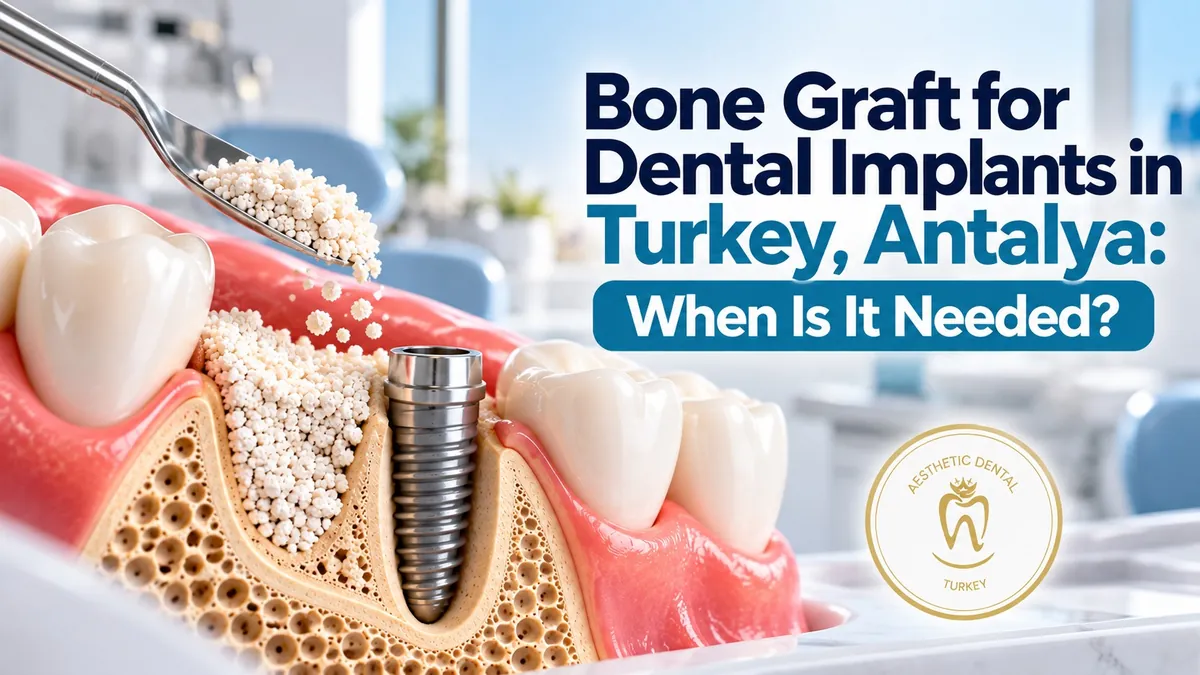
A lot of people come to their first implant consultation expecting a simple answer: one missing tooth, one implant, done. Then the dentist looks at the scan and says the word "graft," and suddenly the plan feels bigger and more complicated than it was a minute ago.
If you've recently been told you need a bone graft, it may sound like an unexpected extra step. Bone grafting is one of the most common procedures in implant dentistry. It isn't a sign that something has gone badly wrong, and it doesn't mean implants are off the table for you. In most cases it's simply the step that makes a long-lasting implant possible.
This guide explains what a bone graft actually is, why some people need one and others don't, how it's done, how long healing takes, and what it means in practice if you're planning dental implant treatment in Antalya, Turkey.
What Is a Dental Bone Graft?
A dental implant is a small titanium (or zirconia) post that replaces the root of a tooth. For an implant to remain stable and function properly, it needs adequate healthy bone around it. Think of it like a fence post: it needs solid ground, not a shallow layer of soil.
A dental bone graft is a surgical procedure that adds bone, or a bone-like material, to the areas of the jaw where there isn't enough. Over the following months, your body gradually builds its own new bone into and around that material. The graft works as a scaffold, and your natural bone does the rest.
Do I Need a Bone Graft for Dental Implants?
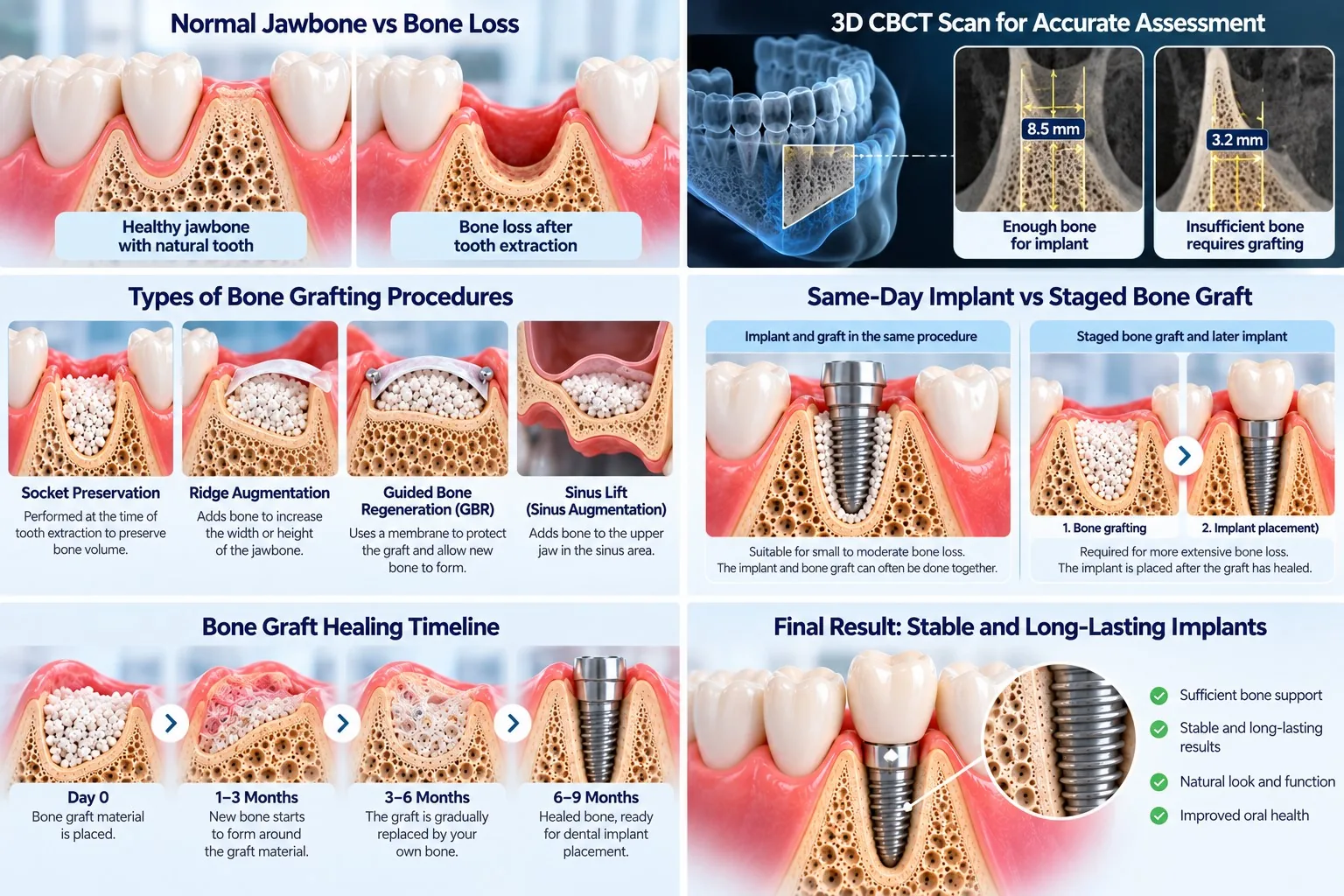
You may need a bone graft before a dental implant if your jaw does not have enough bone height or width to support the implant securely. Bone loss can happen after tooth loss, gum disease, infection or trauma. A dentist can determine whether grafting is necessary after examining your mouth and reviewing a CBCT scan.
Why Is Bone Grafting Sometimes Needed Before Dental Implants?
Jawbone is living tissue, and it stays healthy partly because it's used. The roots of your teeth transmit chewing forces into the bone, and that stimulation keeps it dense and full. When a tooth is lost, that signal stops, and the bone in that spot begins to shrink. Here are the most common reasons a patient ends up with too little bone.
Bone Loss After Tooth Extraction
The alveolar ridge gradually loses width and height after extraction, with substantial remodelling occurring during the first few months. It's a normal part of healing, but it can leave less bone than an implant needs, especially in the front of the mouth where the bone wall is naturally thin.
Bone Loss Caused by Gum Disease
Advanced gum disease (periodontitis) doesn't only affect the gums. The infection slowly destroys the bone that holds the teeth in place. By the time a tooth becomes loose enough to be removed, a good part of its supporting bone may already be gone.
Long-Term Missing Teeth and Jawbone Shrinkage
If a tooth has been missing for years, the bone in that area has had plenty of time to resorb. People who have worn removable dentures for a long time often notice this too: the denture that once fit well starts to feel loose, because the ridge underneath has been shrinking. In the upper back jaw, there's another factor. The maxillary sinus tends to expand downward into the space where the roots used to be, leaving only a thin layer of bone.
Bone Loss After Trauma or Infection
An accident, a fractured tooth, a long-standing abscess or a failed root canal can all damage the surrounding bone. Sometimes the loss is limited to a small area; sometimes it's more extensive and needs careful planning.
How Do Dentists Know If You Need a Bone Graft?
This is worth saying clearly: you can't tell whether you need a bone graft from a photo, a description of your symptoms or an online quiz. Some patients who expect to need one don't, and some who feel completely fine turn out to have significant bone loss. It's decided after a proper clinical assessment and 3D imaging.
Dental Examination and Medical History
Your dentist will look at the gums, the remaining teeth, your bite and the area where the implant would go. They'll also ask about your general health. Diabetes, smoking, certain medications (such as some drugs used for osteoporosis) and previous radiotherapy can all affect how bone heals, so being open about these helps the team plan safely.
3D CBCT Scan and Jawbone Assessment
A regular dental X-ray is flat. It shows height reasonably well but tells you very little about the width of the bone. A CBCT (cone beam computed tomography) scan gives a three-dimensional picture of the jaw, so the dentist can assess the available bone height and width, bone quality, and the position of nearby anatomical structures such as the sinuses and the nerve that runs through the lower jaw.
With that information, the dentist can tell you whether an implant can go in as it is, whether a small graft is enough, or whether a larger reconstruction is needed first.
What Are the Different Types of Dental Bone Grafts?
Bone graft materials are usually grouped into four categories, based on where they come from. Each has its place, and the choice depends on how much bone is needed, where it's needed, and your own preferences.
Autograft – Bone From Your Own Body
This is bone taken from another part of your body, most often from inside the mouth (the chin or the back of the lower jaw) and, for very large reconstructions, sometimes from the hip. Because it's your own living tissue, autogenous bone has traditionally been considered the gold standard for bone grafting because of its biological properties. The trade-off is that it requires a second surgical site, which means a bit more discomfort and a slightly longer recovery.
Allograft – Donor Bone
Allografts come from human donors and are processed and sterilised by licensed tissue banks. They avoid the need for a second surgical site and are widely used around the world.
Xenograft – Animal-Derived Bone
Xenografts are most commonly made from bovine (cow) bone that has been processed until only the mineral structure remains. That structure closely resembles human bone and resorbs slowly, which helps the grafted area hold its shape while new bone forms. If you have dietary or religious concerns about animal-derived materials, mention it at your consultation, because there are alternatives.
Alloplast – Synthetic Bone Graft
These are lab-made materials, such as calcium phosphates or bioactive glass. They're fully synthetic, so there's no donor or animal involved, and they're often used in smaller defects or mixed with other graft types.
In practice, dentists often combine materials. A small amount of your own bone mixed with a xenograft, for example, is a common approach.
What Types of Bone Grafting Procedures Are Used for Dental Implants?
The material is only half the story. The other half is the technique, meaning where the graft goes and how it's placed.
Socket Preservation
This is done at the time a tooth is extracted. Graft material is placed into the empty socket to limit the bone shrinkage that would otherwise follow. If you know you'll want an implant later, it's one of the simplest ways to protect your options.
Ridge Augmentation
When the jaw ridge has become too thin or too short, ridge augmentation rebuilds its width, height, or both. Depending on the size of the defect, this might involve particulate graft material or, for larger defects, a small block of bone fixed in place with tiny screws.
Guided Bone Regeneration (GBR)
GBR uses a thin membrane placed over the graft material. The membrane acts as a barrier, keeping the faster-growing soft tissue out so that bone has the space and time to form. It's one of the most widely used techniques around implants, and it's often done at the same time the implant is placed when the defect is small.
Sinus Lift
In the upper back jaw, the problem is often not the ridge itself but the sinus sitting just above it. A sinus lift gently raises the sinus membrane and places graft material underneath, creating enough height for an implant.
How Is a Dental Bone Graft Performed?
The exact steps vary with the technique, but most bone grafts follow a similar pattern:
- Assessment and planning. Your CBCT scan is used to plan exactly where the graft is needed and how much.
- Anaesthesia. The area is numbed with local anaesthesia. For longer or more extensive procedures, or for anxious patients, sedation may also be offered.
- Preparing the site. The dentist makes a small incision in the gum to expose the bone underneath and cleans the area.
- Placing the graft. The graft material is packed or fixed into the area that needs rebuilding.
- Membrane, if needed. A protective membrane is placed over the graft to keep it stable.
- Stitches. The gum is closed over the area with sutures, which are either dissolvable or removed after about one to two weeks.
- Healing. Over the following months, your body slowly replaces the graft with its own bone.
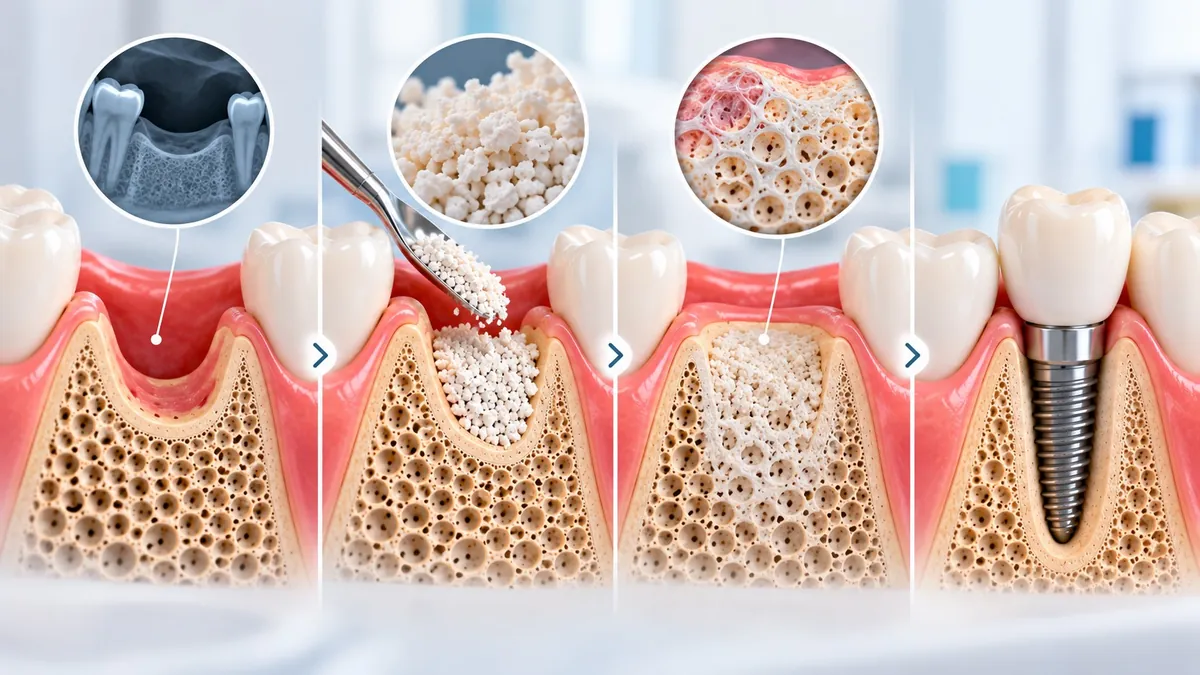
Most patients are surprised by how manageable the procedure itself is. A small socket graft might take less than half an hour; a larger augmentation takes longer.
Can a Bone Graft and Dental Implant Be Done at the Same Time?
Sometimes, yes, and it's one of the questions patients ask most.
If the bone loss is minor, the implant can often be placed and the graft added around it in the same appointment. This is common with GBR when there's enough bone to hold the implant firmly in place, with only a small gap or thin area to fill.
If the bone loss is significant, it's usually safer to do the graft first, let it heal, and place the implant later. An implant needs to be stable from the moment it goes in, and placing it into a large, immature graft increases the risk of problems. Waiting a few extra months can make the difference between an implant that lasts and one that doesn't.
Your dentist will make this decision based on your scan, and sometimes the final call is made during surgery, once the bone can actually be seen.
How Long Does a Bone Graft Take to Heal Before Dental Implants?
There's no single number that applies to everyone. Healing depends on the size of the graft, where it is in the mouth, the material used, and your own health.
Depending on the grafting procedure and individual healing, implant placement may be considered after several months, commonly around three to nine months. Small socket grafts tend to sit at the shorter end of that range. Larger ridge augmentations and sinus lifts usually need longer. Healing time can also vary between different areas of the jaw because bone quality and anatomy are not the same at every implant site.
Your dentist will usually take another scan before implant placement to confirm the graft has matured properly.
What Is Recovery Like After a Dental Bone Graft?
For most people, recovery is closer to "a few uncomfortable days" than "weeks off work." Here's what to expect.
Swelling and Discomfort After Bone Grafting
Some swelling is normal and usually peaks around the second or third day before settling. Bruising can appear, especially after larger grafts. Cold packs on the cheek during the first day, sleeping with your head slightly raised and taking the pain relief your dentist recommends all help. Most patients describe the discomfort as moderate and well controlled with regular painkillers.
If you've had a sinus lift, you'll also be asked not to blow your nose forcefully, and to sneeze with your mouth open for a while, so the sinus membrane isn't put under pressure.
What to Eat After a Bone Graft
Stick to soft, lukewarm or cool foods for the first several days: yoghurt, soups that have cooled down, mashed potatoes, eggs, smoothies eaten with a spoon. Avoid chewing on the grafted side, and stay away from very hot, spicy, hard or crunchy foods until your dentist says otherwise. Skip straws early on, as the suction can disturb the area.
Oral Hygiene During Healing
Keeping the mouth clean matters, but the grafted area needs gentleness. You'll usually be asked not to brush directly over the stitches for the first days and to use a prescribed mouthwash instead. Keep brushing the rest of your teeth normally. Your dentist will tell you when it's safe to return to your usual routine around the graft.
Smoking and Bone Graft Healing
This is the one we'd underline twice. Smoking reduces blood flow to the gums and bone, slows healing and is linked to higher rates of graft and implant failure. If you smoke or vape, tell your dentist before treatment. They can advise you on when to stop before surgery and how long to avoid smoking during healing.
Are There Risks or Complications With Dental Bone Grafting?
Bone grafting has a good track record, but like any surgery it carries some risk. It's better to know about these upfront:
- Infection. This can occur after surgery and should be assessed promptly if symptoms develop.
- The graft not integrating fully. Sometimes part of the graft resorbs or doesn't turn into enough bone, and a top-up graft may be needed.
- Membrane exposure. The membrane can occasionally become visible through the gum during healing. It needs monitoring and sometimes treatment.
- Sinus membrane tear. A possibility during a sinus lift, usually handled during the same procedure.
- Altered sensation. If bone is taken from the lower jaw, there's a small risk of temporary, and rarely lasting, numbness.
Your risk is lower when the treatment is well planned, done by an experienced team and followed by good aftercare. Smoking, poorly controlled diabetes and poor oral hygiene all push the risk up.
How Much Does a Dental Bone Graft Cost in Antalya, Turkey?
Bone graft prices vary quite a lot, and that's not surprising once you know what affects them: the type of material, how much of it is needed, whether a membrane is used, whether it's a simple socket graft or a sinus lift, and whether it's done together with the implant or as a separate surgery.
As an indicative guide, a standard bone graft for dental implants in Turkey may cost around £150–£500 per site. This is an estimated range, not a fixed quote. Larger reconstructions and sinus lift procedures may cost more. Your final price will be confirmed after clinical assessment and review of your X-ray or CBCT scan.
Your bone graft quote should specify the planned procedure, graft material and any membrane required. Ask which assessments and follow-up appointments are included, and whether implant placement is quoted separately. Your final price depends on your assessment and individual treatment plan.
The most accurate way to get a figure is to share a recent panoramic X-ray or CBCT scan with the clinic. That allows the team to give you a treatment plan with real numbers, rather than a guess. Be cautious with prices that look dramatically lower than everywhere else. In grafting, the quality of the material and the experience of the surgeon really do matter.
Bone Grafting for Dental Implants in Antalya, Turkey
Antalya is a well-established destination for international dental patients, with clinics treating patients travelling from the UK and other European countries.
If you're travelling to Antalya for treatment, the main thing to understand about bone grafting is timing. It affects how many trips you'll need:
- No graft, or a small graft placed with the implant: usually two trips. The first for implant placement, and the second, a few months later, for the final crown.
- A separate graft before the implant: often three trips. One for the graft, one for the implant once the bone has matured, and one for the final teeth.
Some clinics can shorten this in certain cases, but healing biology can't be rushed. A good clinic will plan your treatment around your travel schedule without cutting corners on healing time, and will stay in touch while you recover at home.
If you've had a sinus lift, ask your dentist when it is safe to fly before booking your return journey from Antalya.
Do All Dental Implant Patients Need a Bone Graft?
No. Many patients have enough bone height and width for an implant to be placed directly, especially when the tooth was lost recently and there was no major infection.
If you are missing most or all of your teeth in one jaw, full-arch options such as All-on-4 dental implants and All-on-6 dental implants are planned to make the most of the bone you already have. Depending on your scan, this approach can sometimes reduce the need for extensive grafting.
Whether you'll need a graft depends on your individual bone, not on the number of missing teeth or on what someone else was told. The only reliable way to know is a clinical examination and a 3D scan.
Frequently Asked Questions About Bone Grafting for Dental Implants in Turkey
Do I always need a bone graft before getting dental implants?
No. A bone graft is only needed when there isn't enough healthy jawbone to support an implant securely. Many patients go straight to implant placement.
Can I get a dental implant without a bone graft if I have bone loss?
Sometimes. In some cases, alternative implant sizes or positions may be considered, depending on the amount and location of the remaining bone. This can only be determined after clinical and CBCT assessment.
Is a dental bone graft painful?
The procedure is done under local anaesthesia, so you shouldn't feel pain during it. Afterwards, some soreness and swelling are expected and can usually be managed with the pain relief recommended by your dentist.
Can a bone graft and dental implant be placed on the same day?
Yes, when the bone loss is small and the implant can still be held firmly in place. Larger defects usually need to heal before the implant is placed.
How long after a bone graft can I get a dental implant?
Typically somewhere between three and nine months, depending on the size and location of the graft and the technique used. Your dentist will confirm with a scan.
How long does a dental bone graft take to heal?
The gum usually heals within one to two weeks. The bone underneath takes months to mature fully.
What happens if I do not have enough bone for a dental implant?
You'll usually be offered a bone graft, a sinus lift, or an alternative implant approach. Placing a standard implant into insufficient bone isn't recommended, because it's more likely to fail.
Can a dental bone graft fail?
It can, though it isn't common. Smoking, infection, poor oral hygiene and certain health conditions increase the risk. If a graft doesn't take fully, it can often be repeated.
What is the difference between a bone graft and a sinus lift?
A sinus lift is a specific type of bone graft. It adds bone height in the upper back jaw by gently lifting the sinus membrane and placing graft material beneath it. Other bone grafts rebuild the ridge itself or fill an extraction socket.
How much does a bone graft for dental implants cost in Antalya, Turkey?
It depends on the material, the size of the defect and the type of procedure. The clinic can give you an accurate quote after reviewing your X-ray or CBCT scan.
How many trips to Antalya, Turkey are needed for a bone graft and dental implants?
Usually two or three. If the graft is placed with the implant, two trips are often enough. If the graft needs to heal first, plan for three.
Planning dental implant treatment in Antalya? Share your X-ray or CBCT scan with our team to find out whether you need a bone graft and how many trips your treatment may involve.