Dental Implant & Full Mouth Implant
In this article, we will explain dental implant technology, one of the most important and life-changing developments in dentistry, in full detail. We will also discuss the ‘Full Mouth Implant’ treatment, which is a step beyond dental implant technology, especially for those who have lost many teeth or are dissatisfied with their existing dentures.
At Aesthetic Dental Turkey, we offer advanced protocols such as All-on-4 and All-on-6, utilizing 3D surgical guides and digital planning, enabling our patients to achieve fixed, natural-looking teeth on the same day.
At our clinic, we take pride in applying this powerful technology in the most precise and successful manner, with personalized treatment planning for each patient.
What is a dental implant and a dental implant system?
Dental implant
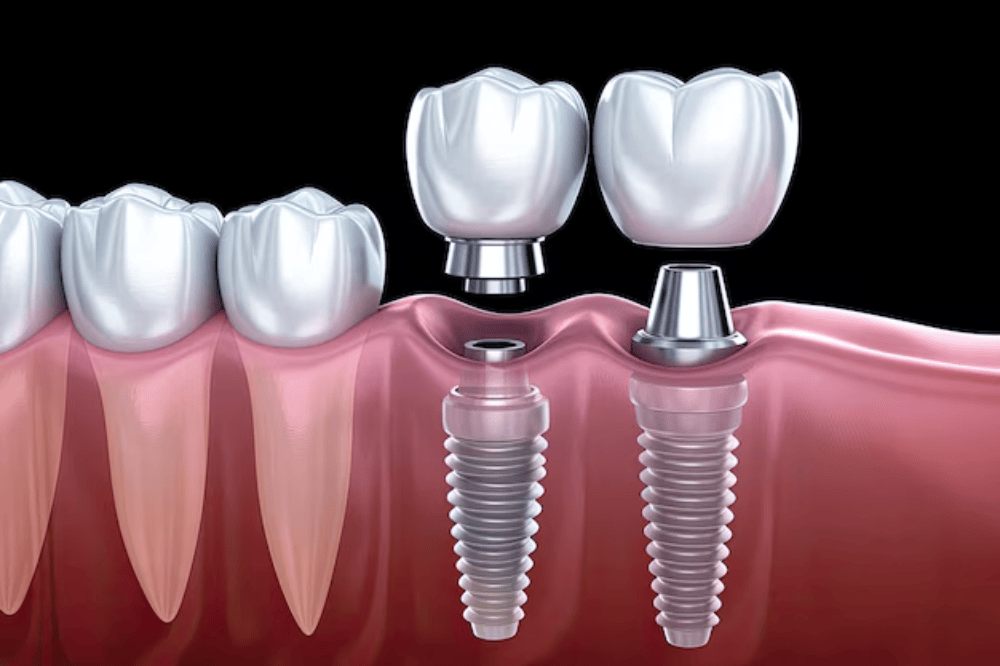
A dental implant is an artificial tooth root made of titanium, shaped like a screw, which is placed into the jawbone to replace the root of a missing tooth. By attaching a natural-looking crown on top, it provides a permanent solution both functionally and aesthetically.
Dental implant system
A dental implant system is not just a titanium screw. The system consists of components including the implant itself, the parts that go on top of it, surgical instruments, laboratory components, and digital planning software. The four basic components of a dental implant system are as follows:
Components placed inside the mouth
Implant screw (fixture):
A screw made of titanium or zirconium that is placed into the jawbone. The surface of the implant screw is roughened using special techniques (sandblasting, acid etching) to allow bone cells to adhere to it.
Abutment (Intermediate connecting element):
A bridge piece connecting the implant screw to the upper prosthesis. There are standard (ready-made), customized (CAD/CAM-produced), and angled (used in inclined implants) types.
Prosthesis (Superstructure):
This is the visible tooth portion that sits on the abutment. Types include single crowns, implant-supported bridges, hybrid prostheses (full mouth), and overdentures (snap-on removable prostheses).
Surgical components (used during the operation)
Surgical guide (Template): A guide printed according to the 3D plan, ensuring the implant is placed exactly where desired.
Bone drills (Freezers): Special drill bits that gradually create a socket in the bone. There are different sizes of freezers for each implant diameter.
Placement tools: Special keys that hold the implant, rotate it, and place it according to the predetermined torque (tightening force).
Prosthesis laboratory components
Analogue (Model implant): An exact replica of the implant in the mouth. It is attached to the working model in the laboratory.
Laboratory abutment: An intermediate piece that enables the prosthesis to be made on the model.
Impression coping: A piece that accurately transfers the position of the implant in the mouth to the impression.
Digital and planning components
CAD/CAM software: Programs used to design the implant position and superstructure on a computer.
3D imaging (CBCT): An imaging technique that produces a three-dimensional map of the bone and nerves.
Titanium:
Dental implants are manufactured from materials specially selected for their biological compatibility and mechanical strength. Today, the most common and proven material in this field is titanium and titanium alloys. Titanium has a property called ‘osseointegration,’ which enables the direct fusion of the implant surface with living bone tissue. This process forms the basis for the long-term stability and success of the implant. Titanium is also highly resistant, lightweight, and extremely resistant to bodily fluids; it does not corrode and is almost never rejected by the body.
Zirconium:
Zirconium (ceramic) implants have been developed as an alternative for patients with metal allergies or high aesthetic expectations. Thanks to its white color, zirconium offers excellent aesthetics, particularly in individuals with thin and transparent gums; it eliminates the risk of the grey color of the implant being visible through the gums. It also exhibits excellent biocompatibility and does not release any metal ions.
Your dentist will assess your bone structure, habits, and aesthetic expectations to select the most suitable material for you.
Dental implants are a versatile treatment option that offers permanent and natural-looking solutions to a wide range of problems, going far beyond simply replacing missing teeth. The main problems that dental implants can solve are as follows:
Missing one or more teeth
When one or more teeth are lost due to decay, trauma, or periodontal disease, a separate implant is placed for each missing tooth. The adjacent healthy teeth are not affected. A porcelain or zirconium crown is placed on top, creating a structure that looks and functions like a natural tooth. It is much more protective and durable than a traditional bridge.
Problems caused by long bridge prostheses
Long bridges made without support teeth at the back may fail due to excessive load or may require the cutting of more than one healthy tooth. Placing an implant in the middle or end of the bridge increases the support point. This extends the life of the bridge, improves force distribution, and ensures that fewer natural teeth are cut.
Problems arising from complete edentulism and removable full dentures
Common complaints among users of removable dentures:
- Prosthesis movement and fear of falling out: Lower jaw prostheses in particular struggle to provide stability.
- Difficulty chewing and dietary restrictions: Hard and fibrous foods cannot be eaten.
- Decreased sense of taste: Taste perception is impaired because the palate is covered.
- Accelerated resorption: The pressure of the denture increases bone loss, requiring the denture to be replaced every 5-7 years.
- Difficulty speaking and slurred speech.
- The need to use adhesive constantly.
- Persistent mouth sores and ulcers.
Implant-based solution (full mouth rehabilitation):
Precision-retained overdenture on 2-4 implants: At least 2 implants are placed, and the denture is secured to these implants using special attachments (‘ball attachment,’ ‘bar,’ etc.). The denture no longer moves or comes loose but can be removed from the mouth for cleaning. This is one of the most economical and effective complete solutions.
All-on-4 / All-on-6 / All teeth fixed (Hybrid / Zirconium bridge): 4, 6, or 8 implants are placed in the jaw, and a completely fixed dental prosthesis that cannot be removed is screwed onto them. The patient can eat, speak, and smile as if they had their natural teeth. Bone loss stops.
Jawbone resorption due to missing teeth (Alveolar resorption)
After a tooth root is extracted, the bone in that area gradually begins to resorb because it no longer receives functional stimulation. This leads to facial collapse (an aged appearance), shifting of adjacent teeth, and makes future prosthesis fabrication more difficult. An implant stimulates the bone like a natural tooth root and stops bone resorption; in some cases, it even preserves bone volume. This helps maintain facial shape and a youthful appearance.
Congenital tooth absence (Congenital anodontia / Hypodontia)
In some individuals, due to genetic reasons, several teeth (usually lateral incisors or small premolars) never form. With traditional methods, adjacent teeth had to be cut to make a bridge. Thanks to implants, an implant is placed directly in the missing tooth area, providing a permanent solution without affecting the young patient's healthy teeth. (Applied after bone development is complete, approximately after the age of 18.)
Extensive tissue and tooth loss following trauma or tumours
Extensive bone and soft tissue loss may occur as a result of accidents or surgical operations. First, the lost tissues are reconstructed using bone grafts and soft tissue surgery. Then, implants are placed, and both function and aesthetics are restored with fixed prostheses.
Problems with removable partial dentures (clasp dentures)
p Clasp dentures have issues such as the clasp retainers being unaesthetic, the mechanical pressure they exert on the teeth, and causing the teeth to become loose over time. The retention of the denture is achieved through specialized, precise connections to the implants rather than hooks. This eliminates the hooks, prevents damage to the teeth, and enhances the stability of the denture.A full mouth implant (complete edentulous mouth rehabilitation) is a comprehensive and permanent dental treatment protocol in which multiple dental implants are placed in the jawbone and a fixed or removable but extremely stable prosthesis is attached to them in cases where all natural teeth in the upper and/or lower jaw have been lost or are too diseased to be saved.
- Those who have lost all their teeth due to decay, periodontal disease, or trauma.
- Patients who are dissatisfied with their current full dentures:
- If the dentures are loose or fall out.
- If chewing efficiency is low, they cannot eat many foods.
- If they have difficulty speaking and develop a lisp.
- If denture sores and pain occur frequently.
- If they are forced to use adhesive (denture cream) constantly.Patients with advanced bone loss who cannot wear conventional dentures.
- Those with lost facial aesthetics and lip support, resulting in an aged appearance.
- Patients who psychologically reject the idea of using ‘false teeth’ and desire fixed teeth.
They are suitable for most adults, but in some cases additional precautions are required or the risk increases:
- Those requiring careful assessment include patients with uncontrolled diabetes, those taking bisphosphonate medication for bone loss (osteoporosis) (especially intravenously), patients who have undergone radiotherapy to the head and neck region, heavy smokers, and pregnant women.
- It is recommended to wait until bone development is complete in young patients (usually 18-21 years of age).
What are full-mouth implant protocols?
Fixed prosthesis options
All-on-4 (Full prosthesis on four implants)
Four implants are placed in each jaw with a special angular placement. The rear implants are positioned at a 30-45 degree angle, bypassing the rear areas with low bone quantity and allowing for the use of longer implants. It is suitable for most completely edentulous patients with moderate bone loss.
Advantages:
- Bone grafting (augmentation) is usually not required. The angled placement allows avoiding sinus lifting or advanced bone grafting procedures.
- Fixed teeth on the same day. A temporary fixed prosthesis is fitted on the same day after the implants are placed.
- The cost and treatment time are significantly lower compared to placing a single implant per tooth.
All-on-6 / All-on-8
Six or eight implants are placed in the jaw to create more support points for the prosthesis. Suitable for young to middle-aged patients with good bone quality and high expectations.
Advantages:
- More support: better force distribution and potentially longer lifespan.
- The cantilever (the free tooth section extending beyond the supporting implants) is much shorter or nonexistent.
Individual implants (one implant per tooth)
This involves placing a separate implant for each missing tooth. It is the most natural-looking but also the most expensive method, with high bone requirements.
It is suitable for patients with minimal bone loss and high financial means who desire maximum naturalness.
Removable (movable) but stable prosthesis options
Implant-supported precision attachment prosthesis (Overdenture)
At least 2 implants are placed in the lower jaw and at least 4 in the upper jaw. The prosthesis is attached to these implants using special attachment heads (ball attachment, locator) or a bar. It is a good solution for patients with limited budgets or elderly patients as a first step towards transitioning from a removable to a fixed prosthesis.
Advantages:
- The prosthesis no longer moves or falls out. However, it can be removed and cleaned by the patient.
- Chewing efficiency increases by 70-80% compared to removable full dentures.
- It is the most economical full-mouth implant solution.
- Cleaning and maintenance are relatively easier.
Dental implant treatment is a comprehensive protocol involving meticulous planning, precise surgery, and a careful recovery process. The procedure is not completed in a single session; it consists of a series of stages.
Pre-treatment preparation and planning
Comprehensive examination and medical history:
Intraoral examination: Existing teeth, gum health (periodontal status), oral hygiene, and occlusion are examined in detail.
Medical history: Systemic diseases (diabetes, heart disease, osteoporosis), medications used (especially anticoagulants and bisphosphonates), allergies, and smoking are recorded. If necessary, consultation with the patient's doctor is arranged.
Radiological imaging
Panoramic X-ray: Provides a general preliminary idea but is not sufficient.
3D dental computed tomography (CBCT): With this imaging,
- Bone quality and quantity: The bone density and height/width of the area where the implant will be placed are measured in millimeters.
- Map of critical anatomical structures: The exact 3D position of the inferior alveolar nerve canal and mental foramen in the lower jaw and the maxillary sinus cavity and nasal cavity in the upper jaw are determined. The position of adjacent tooth roots is visible.
Digital planning and surgical guide (template) design:
CBCT data is transferred to special implant planning software. The dentist, in a virtual environment:
- Selects the ideal brand, diameter, and length of the implant.
- Determines the most suitable 3-dimensional position of the implant (mesial-distal, buccal-lingual, apical-coronal).
- Determines the most accurate angle of the implant.
This virtual plan is converted into a plastic plate called a ‘surgical guide’ or ‘template’ using a 3D printer, which fits over the patient's teeth/gums. The metal guide tubes inside this template ensure that the surgeon places the implant precisely in the planned location.
Patient preparation:
Optimization of oral hygiene: Any gum disease (periodontitis) is treated. Professional teeth cleaning is performed.
Premedication: If deemed necessary, antibiotics or painkillers may be prescribed prior to surgery.
Patient consent: The entire process, risks, alternatives, and costs are discussed in detail with the patient, and written consent is obtained.
Surgical procedure (Implant placement)
The procedure is usually performed comfortably under local anesthesia. Sedation or general anesthesia are also options for patients with high anxiety.
Sterilisation and draping
The mouth is cleaned with an antiseptic mouthwash. The face is covered with sterile drapes.
Incision of the gingival flap (flap design)
Traditional method: The gingiva in the implant area is incised in a ‘U’ shape and lifted to reach the bone level (flap technique).
Flapless technique: When a surgical template is used, only a small hole is made in the gum along the template's guide tube. This method does not require stitches, and healing is faster and painless.
Creating a socket in the bone (Osteotomy)
- The surgical template is placed.
- Using special, cooled (with sterile physiological saline) surgical drills, the socket for the implant is gradually opened in the bone (e.g., first 2.0 mm, then 2.8 mm, and finally 3.5 mm).
Placement of the implant screw
- The selected titanium implant is held in a special ‘carrier’ and advanced into the prepared socket at low speed.
- The implant is tightened to a predetermined torque value. This indicates the primary stability of the implant within the bone.
- A ‘cover screw’ is placed on top of the implant.
Closure and suturing
- In the flap technique, the gingival flap is replaced and sutured. This step is not performed in the flapless technique.
- Sutures are usually self-dissolving or are removed after 7-10 days.
Healing and osseointegration period
This is the waiting period during which the biological process is expected to be completed.
Duration: On average, 2-3 months for the lower jaw and 3-4 months for the upper jaw. The healing period is longer for the upper jawbone because it is more porous.
Osseointegration: Bone cells (osteoblasts) grow towards the titanium implant surface, forming a functional and structural bond. The implant now becomes part of the jawbone.
Temporary prosthesis: During this period, the patient is fitted with a temporary prosthesis (usually removable) that does not put pressure on the implant site.
Prosthetic phase
Once the implant has fully fused with the bone, the visible tooth is constructed on top of it.
Second minor surgery (Abutment placement)
Under local anesthesia, the small gum tissue covering the implant is opened, the cap is removed, and the healing abutment is fitted. This allows the gum to mold around the implant (1-2 weeks).
Taking measurements
The healing cap is removed. A ‘transfer cap’ is placed to accurately transfer the position of the implant in the mouth to the laboratory, and a highly precise measurement is taken (traditional or digital measurement).
Laboratory process
A working model is created from the impression taken, into which a ‘model analogue’—an exact replica of the implant—is placed.
The dental technician first prepares the abutment (ready-made or custom-made using CAD/CAM) on this model, then prepares the porcelain/zirconium crown or bridge to be placed on top.
Placement of the Prosthesis
- The abutment is screwed onto the implant screw and tightened to a specific torque.
- The crown/bridge is either permanently cemented onto the abutment or fixed with screws (screw-retained crowns are advantageous in terms of cleanability).
- A final check is performed with occlusion control and X-ray.
The first 24-48 hours after surgery
- After surgery, bite down on the gauze pad placed in your mouth for 30-60 minutes. This is critical for clot formation.
- Slight bleeding in the form of oozing is normal for 24-48 hours. In case of excessive bleeding, bite down on a clean gauze pad and apply pressure for 30 minutes. Spitting, vigorous rinsing, and using a straw can dislodge the clot and cause bleeding to resume.
- For the first 48 hours, apply a cold compress to the outside of the implant area (through the cheek) for 20 minutes, then take a 20-minute break. This minimizes swelling and pain.
- Take the antibiotics and painkillers prescribed by your dentist as directed. Painkillers taken before pain occurs are more effective.
- Consume cold and soft foods on the first day (yogurt, pudding, cold soup, ice cream). Avoid hot, spicy, hard, acidic, and seeded foods.
- Rest, limit physical activity, and sleep with your head elevated.
First week
- After the first 24 hours, brush your other teeth with a soft toothbrush without touching the implant site. Use alcohol-free, special mouthwashes (usually chlorhexidine-based) as recommended by your dentist.
- Sutures usually dissolve on their own or are removed after 7-10 days. Do not brush or disturb the area during this time.
- Avoid chewing on the implant site for at least 2 weeks. Avoid pressure, even with teeth on the opposite jaw.
Long-term implant care
- Excellent oral hygiene is essential: Implants do not decay, but infection (peri-implantitis) can develop around them.
- Brush twice daily with a soft/medium-bristled toothbrush.
- Clean around the implant daily using special dental floss (Super Floss) or an interdental brush.
- Using an electric water flosser (Waterpik) is very effective in removing plaque.
- Never neglect regular dental check-ups: be sure to visit your dentist every six months. Your dentist will measure the pocket depths around the implant, perform professional cleaning, and check the bone level with an X-ray.
- Pay attention to your prosthesis and teeth grinding (bruxism): If you are advised to use a night guard, do not neglect it. Do not crack hard-shelled foods (walnuts, hazelnuts) with your implant teeth.
- Maintain your general health: Uncontrolled diabetes increases the risk of infection around the implant. Calcium and vitamin D are important for bone health.
Advantages of single and multiple dental implants
No need to touch adjacent healthy teeth
The two healthy teeth next to the missing tooth are cut down and capped to support the bridge. Since the implant is an independent artificial tooth root, the adjacent teeth are not touched at all. This preserves the health and integrity of those teeth for decades.
Preservation of the jawbone and anti-ageing effect
After tooth loss, the bone in that area begins to rapidly resorb (break down) because it no longer receives stimulation. The implant transmits chewing forces to the bone, just like a natural tooth root. This functional stimulation stops bone resorption and preserves existing bone. As a result:
- Facial shape and lip fullness are preserved, preventing sagging around the mouth and an aged appearance.
- A healthy foundation is maintained for future prosthetics.
Superior chewing efficiency
- Crowns on implants provide chewing force very close to that of natural teeth.
- Foods that are difficult to eat with removable dentures, such as apples, carrots, meat, hard bread, and nuts, can be eaten comfortably and enjoyably with implants.
- Food is chewed more effectively, relieving the digestive system and contributing positively to overall health.
Aesthetic and natural appearance
- Today's ceramic and zirconium materials mimic the natural tooth in both shape and light transmission.
- The gum line appears natural and healthy. Thanks to implant abutments, the risk of a grey line or metal appearance resulting from ‘gum recession’ is minimal.
Long-lasting and cost-effective
- A well-maintained implant can last for decades, even a lifetime.
- Traditional bridges need replacing after an average of 10-15 years, and building new bridges becomes difficult as the underlying bone deteriorates.
- In the long term, implants are a more economical and hassle-free option.
Easy maintenance and cleaning
- An implant-supported crown is brushed and flossed just like a natural tooth.
- There is no need for special cleaning tools, as with bridges, or for removal procedures, as with removable dentures.
Advantages of full mouth implants:
Full mouth implants (all-on-4, all-on-6, and hybrid dentures) change the lives of patients who use removable full dentures.
Stability:
Lower jaw full dentures constantly move, fall out, and get stuck under food due to tongue and cheek movements. The denture is either completely fixed to 4-6 implants (fixed denture) or held very tightly to the implants with precision attachments (overdenture). There is no movement, slipping, or falling out. The patient has no worries whatsoever when eating, laughing, or talking.
Increased chewing power
Chewing efficiency with dentures is only 20-30% of that with natural teeth. Many foods are avoided, leading to a decline in nutritional quality. With full-mouth implants, chewing efficiency reaches levels close to that of natural teeth (80-90%). The patient can chew anything they want (meat, vegetables, fruit, nuts).
Sense of taste and temperature sensation
When using dentures, the upper palate is completely covered by the denture, causing a significant decrease in the sense of taste. The temperature of food cannot be felt. With full mouth implants, the palate remains completely exposed. In overdentures, the denture is thin and does not cover the palate. The sense of taste is fully restored, and the true flavor and temperature of food and beverages can be perceived.
Halting bone loss and preserving facial aesthetics
The pressure exerted by the prosthesis on the bone causes it to deteriorate even more rapidly. The prosthesis must be replaced every 5-7 years. Over time, the jaw shrinks, the lips collapse, wrinkles increase around the mouth, and an aged appearance develops. Implants functionally stimulate the jawbone and completely halt bone loss. Facial shape, lip fullness, and a youthful appearance are preserved. This is the most important biological advantage of implants.
Clear speech and self-confidence
With dentures, slurred speech, spitting, and ‘whispering’ sounds occur.
With fixed teeth, clear, understandable, and confident speech is achieved. Self-confidence increases in social interactions.
Psychological relief and improved quality of life
- Elimination of the ‘false teeth’ complex: Having fixed teeth makes a person feel younger, healthier, and more attractive.
- Full participation in social life: Restrictions such as avoiding dinner invitations, covering one's mouth when laughing, or feeling self-conscious when kissing are eliminated.
- Sleep comfort: They are more comfortable and convenient, as there is no need to remove and clean them at night.
Long-term economic advantage
As bone deteriorates, dentures need to be replaced, adhesive (cream) needs to be purchased frequently, and repair costs arise. Full mouth implants, on the other hand, are a one-time, long-lasting investment. With regular maintenance, they can be used without problems for decades.
Is getting an implant a painful procedure?
No, nowadays implant surgery is a painless procedure thanks to modern anesthesia techniques. During the procedure, the area is completely numbed with local anesthesia, and you will only feel pressure. Mild swelling and pain lasting 2-3 days after the procedure is normal and can be easily managed with prescribed painkillers. This process is quite comfortable thanks to the minimally invasive techniques used by experienced dentists and cold compresses.
How long do implants last? Can they be used for life?
Dental implants can be used for life with proper planning, high-quality materials, successful surgery, and, most importantly, excellent patient care. Thanks to titanium's biological compatibility, it fuses with the bone and becomes permanent. However, the prosthesis (porcelain crown) on top may need to be replaced after many years due to wear or mechanical reasons. There are success stories spanning 30-40 years. The factors that most threaten success are inflammation around the implant (peri-implantitis) and poor oral hygiene.
When will I have fixed teeth with full mouth implants?
With modern protocols (All-on-4, All-on-6), you will have fixed teeth on the same day. After the implants are placed, a pre-prepared temporary acrylic prosthesis is attached to the implants, and you will not leave the clinic without teeth. You will eat a soft diet for 3-4 months with this temporary prosthesis. Once the bone integration is complete, your permanent zirconium or hybrid prosthesis will be fitted.
I smoke. Can I have an implant?
Yes, you can, but your chances of success are significantly reduced and the risks increase. It is recommended that you quit at least one week before surgery and refrain from smoking during the healing period (3-4 months). This dramatically increases your chances of success.
Smoking:
- Slows down healing by constricting blood vessels.
- Increases the risk of infection by 2-3 times.
- Can impair bone fusion (osseointegration).
I have bone loss. Can I still have implants?
Yes, in most cases you can. Modern implant techniques offer solutions for bone loss:
- Bone grafting (Additional bone powder): Used to rebuild missing bone.
- Sinus lift: A bone augmentation procedure in the back of the upper jaw.
- All-on-4 technique: Fixed prostheses can be made even in short bones using angled implants.
- Short implants: Used when there is insufficient bone height for standard implants.
- Zygoma implant: In cases of advanced bone loss, the implant is extended into the cheekbone.