

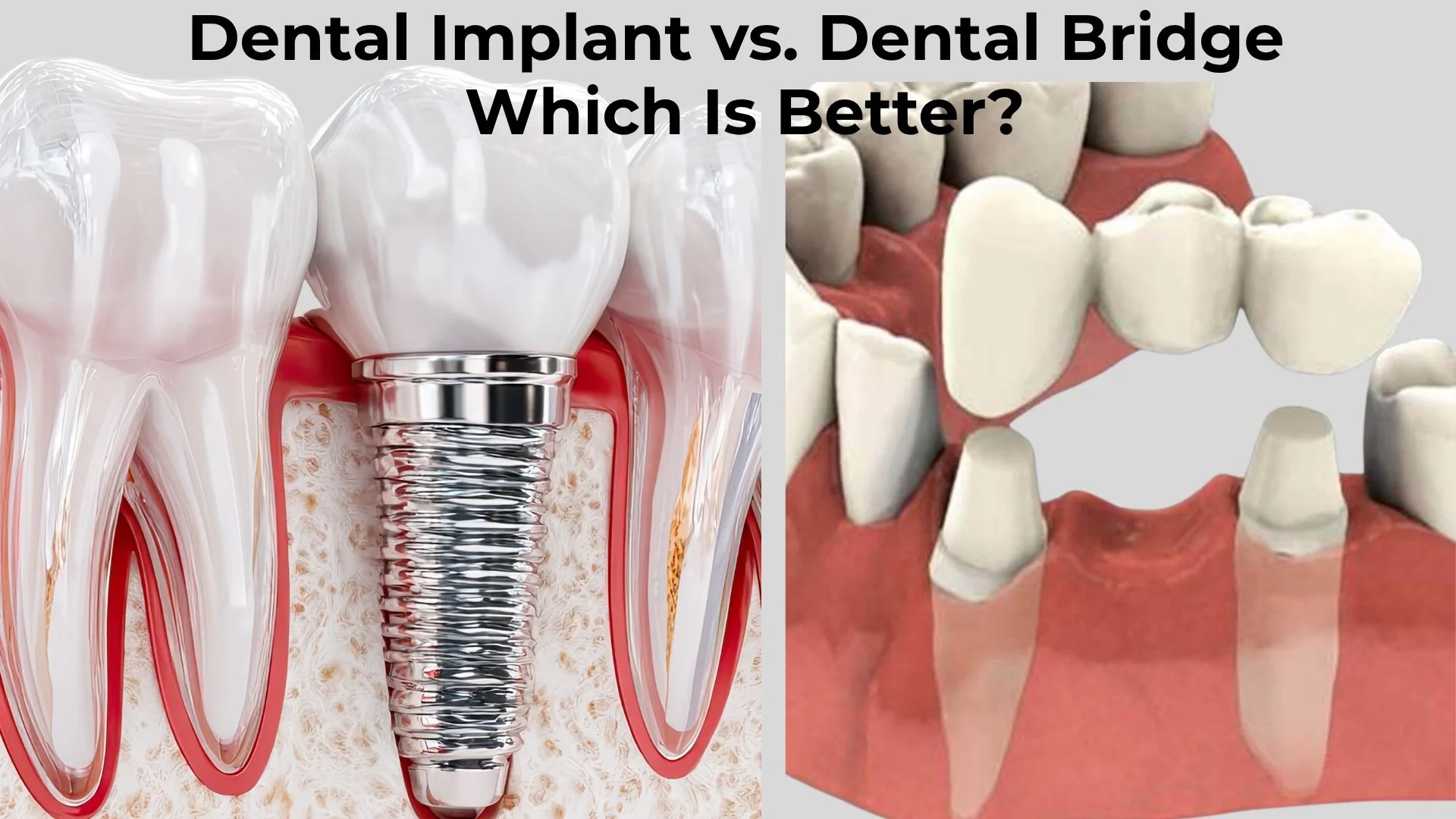
If you've lost a tooth and started looking into replacement options, you've probably run into the same two names over and over: dental implants and dental bridges. Both do the same basic job—filling the gap—but they go about it in very different ways, and the "better" choice depends on your specific situation rather than one option being universally superior.
Here's a proper breakdown of how they compare, so you can walk into your dentist's office with a clearer idea of what questions to ask.
The Basics: How Each One Works

Dental Implant
A dental implant replaces the entire tooth, root included. A titanium post is surgically placed directly into the jawbone, where it's given time to fuse with the bone in a process called osseointegration. Once that's done — usually a few months later — a custom crown is attached on top, and the result functions and looks like a natural tooth, standing entirely on its own.

Dental Bridge
A dental bridge, on the other hand, doesn't touch the jawbone at all. It replaces the visible part of the missing tooth by anchoring a false tooth (or teeth) to the natural teeth on either side of the gap. Those neighbouring teeth are shaved down and fitted with crowns, which support a connected false tooth in between—essentially "bridging" the space.
That one structural difference—root replacement versus support from neighbouring teeth—is what drives almost every other difference between the two.
Jawbone Health: The Biggest Long-Term Difference
This is probably the most important distinction, and the one most people don't think about until later.
Every time you bite down with a natural tooth, the root sends pressure into the jawbone, which signals your body to keep that bone dense. Once a tooth (and its root) is gone, that stimulation stops, and the bone in that area gradually starts to shrink—a process that can begin within months.
A dental implant recreates that root-level stimulation, since the titanium post takes over that job. This means implants actively help preserve jawbone density over time.
A bridge does nothing for the bone underneath the gap, because there's no root there. Bone resorption continues the same way it would if the space were left empty. Over years, this can lead to a sunken area under the bridge and, in some cases, changes to facial appearance.
If long-term bone health is a priority—and for most people, it should be—this is where implants generally offer a clear advantage.
Durability and Lifespan
This is another area where the gap between the two options is significant.
Dental implants, when properly placed and cared for, can last several decades—many patients keep the same implant for the rest of their lives. The crown on top may eventually need replacing due to normal wear, but the implant itself is built to be a permanent fixture.
Dental bridges have an expected lifespan of 10 to 15 years, although some may last longer with excellent care. The bridge relies on the supporting teeth; if either of those teeth develops decay or gum disease, the whole bridge can be compromised—meaning a single weak point can affect the longevity of the bridge.
If you're thinking in terms of decades rather than years, implants tend to be the more durable solution.
Treatment Time and Process
This is the one area where bridges have a clear edge.
A dental bridge can typically be completed in two visits over a couple of weeks—one to prepare the supporting teeth and take impressions, another to fit the finished bridge. There's no surgery involved, and no lengthy healing period.
Implants take considerably longer. After the implant post is placed, it needs 3 months to properly fuse with the jawbone before the crown can be attached. If bone grafting is needed first (common in patients who've had a gap for a while), that adds even more time. The upside is that, once treatment is complete, implants generally require replacement far less often than dental bridges.
If you need a faster fix, or if you have health issues that make you a poor candidate for surgery, a bridge is often the more practical short-term solution.
Cost Considerations
Bridges usually cost less upfront than implants—sometimes considerably less. This makes them an appealing option for patients working with a tighter budget or needing to replace multiple adjacent teeth without the added expense of individual implants for each one.
Implants have a higher initial cost, largely because of the surgical component, the materials involved, and the healing time required. However, it is important to consider the long-term cost rather than just the initial investment. Although implants cost more initially, many patients find them more cost-effective over time because they typically last much longer and require fewer replacements.
Who Benefits More From Each Option
A dental implant is usually the stronger long-term choice if:
- You want to preserve your jawbone density
- You'd rather not alter healthy neighbouring teeth
- You're looking for a solution designed to provide long-term stability
- You have sufficient bone (or are open to a bone graft) and are otherwise healthy enough for minor surgery
A dental bridge may make more sense if:
- You need a faster solution with no surgery
- The teeth next to the gap already need crowns for other reasons
- You have medical conditions that make surgery risky
- Budget is a significant, immediate constraint
Implant vs. Bridge Recovery
A dental bridge does not require surgery, so recovery is usually minimal. Patients may experience mild sensitivity after the supporting teeth are prepared, but they can typically return to normal activities immediately. Dental implants require a surgical procedure followed by a healing period of approximately 3 months, during which the implant fuses with the jawbone through a process called osseointegration. Although recovery takes longer, the result is a stronger and more permanent tooth replacement.
Impact on Neighbouring Teeth
One of the biggest differences between dental implants and dental bridges is how they affect the surrounding teeth. A dental bridge relies on the natural teeth next to the gap for support, which means they must be reshaped and fitted with crowns—even if they are completely healthy. While this is a well-established and effective treatment, it permanently alters the supporting teeth.
A dental implant, on the other hand, is placed directly into the jawbone and does not depend on neighbouring teeth for support. This allows the adjacent teeth to remain completely untouched, preserving their natural structure. For patients who want to protect healthy teeth and maintain as much natural tooth structure as possible, dental implants are generally considered the more conservative long-term option.
Which Looks More Natural?
Both dental implants and bridges can produce highly natural-looking results when carefully planned and placed. However, dental implants often have a slight aesthetic advantage because the implant crown emerges naturally from the gum, closely mimicking the appearance of a real tooth. A bridge replaces the missing tooth by suspending an artificial tooth between adjacent teeth, so it does not emerge from the gum in the same way. While the difference is usually subtle, implants often provide the most natural-looking result, particularly over the long term.
Dental Implant vs Dental Bridge: Comparison Table
| Factor | Dental Implant | Dental Bridge |
|---|---|---|
| What it replaces | Full tooth, including the root | Only the visible portion of the missing tooth |
| Impact on neighbouring teeth | None — placed independently | neighbouring teeth must be filed down |
| Jawbone health | Preserves bone density (root stimulation) | Does not prevent bone loss under the gap |
| Procedure | Surgical placement in the jawbone | No surgery; crowns fitted on adjacent teeth |
| Treatment time | 3 months (including healing) | 2–3 weeks (2 visits) |
| Lifespan | 20+ years, often a lifetime | 10–15 years on average |
| Recovery | Mild soreness/swelling for a few days | Minimal |
| Natural appearance | Very natural; emerges from gum like a real tooth | Natural-looking, but sits on top of the gum |
| Upfront cost | Higher | Lower |
| Long-term cost | Often lower over time (rarely needs replacement) | Can add up with periodic replacement |
| Candidacy | Requires sufficient bone density and good general health | Suitable for most patients; no bone requirement |
| Best suited for | Long-term durability, single missing tooth or a few gaps | Faster, budget-friendly fix; teeth already needing crowns |
Conclusion
Implants are generally considered the preferred solution when preserving oral health, jawbone density, and long-term durability is the priority, while bridges remain a legitimate, faster, and less expensive solution for the right circumstances.
The best way to figure out which applies to you is a proper evaluation: your dentist can assess your bone density, the health of your remaining teeth, your medical history, and your budget, and help you weigh the trade-offs based on your specific mouth — not just a generic comparison. Both options can genuinely restore your bite and your smile; the right one is simply the one that fits your particular situation best.
Frequently Asked Questions
Is getting an implant painful?
The procedure itself is done under local anaesthesia, so you shouldn't feel pain during placement. Some soreness and swelling afterward is normal for a few days, but most patients describe it as manageable with over-the-counter pain relief—comparable to having a tooth extracted.
Can I replace a bridge with an implant?
Yes. In many cases, a failed or aging dental bridge can be replaced with a dental implant, provided there is enough healthy jawbone to support it. If a bridge fails, or if a patient simply wants to move to a longer-term solution, the bridge can be removed and an implant placed instead — though the previously prepared supporting teeth will usually need a new crown of their own once the bridge is gone.
Can everyone get dental implants?
Not automatically. Candidates need adequate jawbone density and generally good health, since healing depends on the body's ability to recover from minor surgery. Conditions like uncontrolled diabetes or heavy smoking can complicate things, but many patients who initially lack enough bone can still qualify after a bone graft.
Which lasts longer, a dental implant or a bridge?
A dental implant typically lasts longer than a bridge, generally by a significant margin. With proper care, implants can last 20-25 years or even a lifetime, while bridges typically need to be replaced after 10 to 15 years.
Are dental implants better than bridges?
For most people thinking long-term, implants are usually considered the better option—they help preserve jawbone density, don't require altering healthy neighbouring teeth, and tend to last much longer. That said, "better" depends on the situation: bridges are faster, cheaper upfront, and don't involve surgery, so they can still be the more practical choice for certain patients or budgets. It's really a case-by-case decision best made with a dentist.
Please contact us for detailed information.