

Dental veneers are one of the most commonly used cosmetic dentistry treatments for improving the colour, shape, size and overall appearance of teeth.
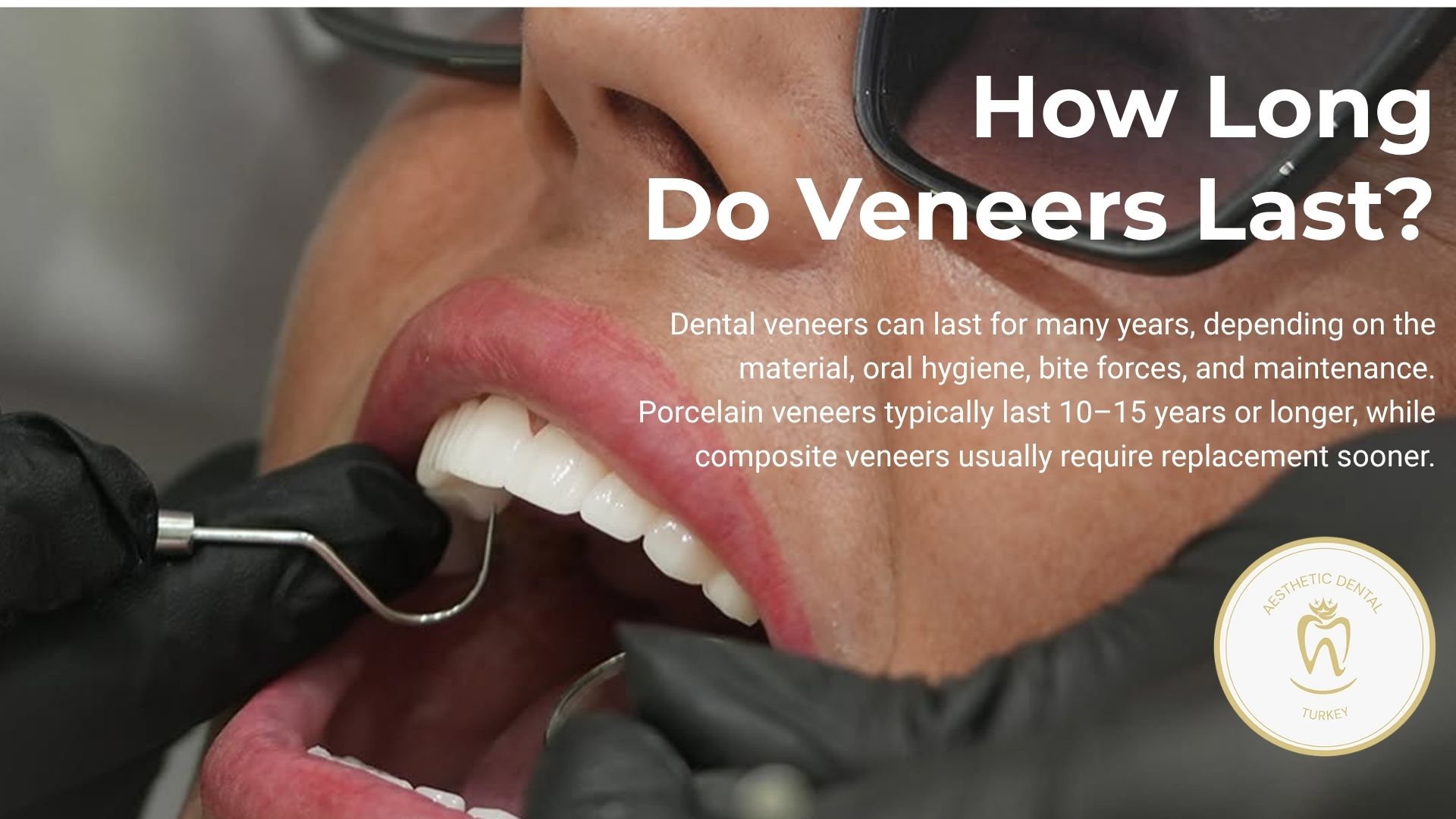
Dental veneers can last for many years, depending on the material, oral hygiene, bite forces and maintenance. Porcelain veneers typically last 10–15 years or longer, while composite veneers usually require replacement sooner.
What are veneers?
Veneers are thin, custom-made shells bonded to the front surface of teeth. Their thickness varies depending on the material, preparation technique and clinical requirements, with some ultra-thin veneers requiring minimal or, in selected cases, no tooth preparation.
Today, advances in dental materials and adhesive bonding have made veneers a durable, long-term option for improving dental aesthetics.
Are veneers permanent?
Veneers are considered a long-term restorative treatment. Conventional porcelain veneers often require some enamel removal, making the treatment generally irreversible. However, “permanent” does not mean that veneers will last forever. Over time, veneers may wear, chip, become loose or require replacement due to changes such as gum recession. Some no-prep or minimal-prep veneers preserve substantially more enamel, but whether treatment can be considered reversible depends on the individual case and technique used.
When tooth preparation is required, your dentist removes a thin layer of enamel from the front surface of the tooth. Because removed enamel does not regenerate, teeth that have been prepared for conventional veneers will generally require ongoing restorative coverage in the future.
No-Prep Composite Bonding Treatment

No-Prep Composite Bonding Treatment
Antalya, Turkey
This patient wanted a more confident smile but preferred to avoid having his natural teeth shaved or reduced.
Following a detailed smile analysis, no-prep composite bonding was recommended, allowing his smile to be enhanced without removing healthy tooth structure typically required for veneer preparation.
— Aesthetic Dental Clinic, Turkey
What affects the durability of veneers?
The factors determining how long veneers will last are as follows:
- Bonding surface (enamel vs. dentin): Bonding veneers to tooth enamel yields much stronger and more predictable results than bonding them to the underlying dentine.
- Parafunctional habits: Habits such as teeth grinding (bruxism), clenching, nail-biting or pen-chewing can create excessive pressure on the porcelain, leading to cracking, chipping or detachment.
- Oral hygiene: Bacterial plaque forming along the edges of veneers or gum disease can compromise the underlying natural tooth structure, leading to failure.
- Clinical technique: Accurate treatment planning, conservative tooth preparation, precise impressions or digital scans, proper isolation and a carefully controlled bonding protocol can all influence the long-term success of veneers.
How to make your veneers last longer?
To ensure your veneers last for many years, we recommend following these simple yet effective guidelines:
- Good oral hygiene: Brush your teeth twice a day and clean between your teeth regularly, following your dentist's recommendations.
- Use of a night guard: If you grind or clench your teeth, your dentist may recommend a night guard to help protect the veneers from excessive forces.
- Avoid biting very hard objects: Avoid chewing ice, cracking nut shells with your teeth or biting other very hard objects that may increase the risk of chipping or fracture.
- Avoid damaging habits: Nail-biting, chewing pens or using your teeth to open packaging can increase the risk of veneers chipping, breaking or becoming loose.
- Regular check-ups: You should visit your dentist at least twice a year to ensure the edges of your veneers and the health of your gums are professionally assessed.
- Choose a non-abrasive toothpaste: Use a toothpaste that is suitable for cosmetic restorations and avoid highly abrasive products that may affect the surface finish of veneers. Your dentist can recommend an appropriate toothpaste based on your oral health needs.
How long do composite veneers last?
- Composite veneers generally have a shorter lifespan than porcelain ones and commonly last around 3–7 years, although their lifespan varies depending on oral hygiene, bite forces, dietary habits, smoking, bruxism and maintenance.
- As composite material is more porous than porcelain, it is more prone to discolouration and staining over time due to external factors such as tea, coffee or smoking.
- Its resistance to chewing forces is not as high as that of porcelain, which can lead to wear and edge fractures over time.
- Whilst porcelain veneers can typically last 10–15 years or longer with proper care, composite veneers generally have a shorter lifespan. One advantage of composite veneers is that minor chips or damage can often be repaired directly in the mouth without replacing the entire restoration.
How long do porcelain veneers last?
Porcelain veneers typically last 10–15 years or longer with good oral hygiene and appropriate maintenance. Their actual lifespan varies depending on factors such as bonding quality, bite forces, oral habits and the condition of the underlying teeth.
Clinical studies generally report high long-term survival rates for porcelain veneers, particularly when a substantial proportion of the restoration is bonded to enamel rather than dentine.
How long do different types of ceramic veneers last?
The lifespan of ceramic veneers depends on the type of ceramic used, the quality of the bonding, the amount of enamel available for adhesion, bite forces, oral hygiene and individual habits such as teeth grinding. In general, well-planned and properly maintained ceramic veneers can remain functional and aesthetically pleasing for many years.
E-max (Lithium Disilicate) Veneers
E-max veneers are made from lithium disilicate, a glass-ceramic material widely used in cosmetic dentistry because of its combination of strength and natural translucency. Clinical studies have reported high survival rates for lithium disilicate veneers over medium- and long-term follow-up periods.
With appropriate case selection, precise adhesive bonding and good oral care, E-max veneers can commonly last 10–15 years or longer. Their actual lifespan varies considerably between patients, so they should not be expected to last for a guaranteed number of years.
Feldspathic Porcelain Veneers
Feldspathic porcelain is one of the traditional materials used for highly aesthetic veneers. Because it can be fabricated in very thin layers, it can reproduce the translucency, colour and optical characteristics of natural enamel particularly well.
Feldspathic porcelain veneers can remain successful for 10 years or longer when they are primarily bonded to healthy enamel and properly maintained. Their longevity depends heavily on the bonding surface, occlusion, preparation design and the patient's oral habits.
Other Ceramic Veneers
Other dental ceramics may also be used depending on the patient's tooth structure, aesthetic requirements and functional needs. Different ceramic systems have different mechanical and optical properties, so there is no single lifespan that applies to every type of ceramic veneer.
Rather than choosing a veneer material based only on expected longevity, the dentist should consider factors such as the amount of remaining enamel, tooth colour, bite forces, tooth position and the desired aesthetic result.
Which ceramic veneer lasts the longest?
There is no single ceramic material that can be considered the longest-lasting option for every patient. Correct case selection and strong bonding to enamel can be just as important as the ceramic material itself.
For patients with sufficient healthy enamel and suitable bite conditions, both lithium disilicate and feldspathic porcelain veneers can provide predictable long-term results. Regular dental check-ups, good oral hygiene and management of bruxism can further help extend their lifespan.
How long do zirconia veneers last?
Zirconia can be used for selected veneer restorations where additional strength or masking ability is required. Modern high-translucency zirconia can provide a combination of strength and aesthetics, although its suitability depends on the individual clinical situation.
The longevity of zirconia veneers depends on factors such as case selection, surface treatment, bonding quality, bite forces, oral hygiene and habits such as teeth grinding. For this reason, an exact lifespan cannot be guaranteed for every patient.
Porcelain vs Composite Veneers
| Feature | Porcelain Veneers | Composite Veneers |
|---|---|---|
| Material | High-strength dental ceramic | Tooth-coloured composite resin |
| Lifespan | Typically 10–15 years or longer with good care | Typically 3–7 years, depending on care and oral habits |
| Thickness | Thin; varies according to the material and preparation design | Varies according to the amount of material required |
| Aesthetics | Excellent natural translucency and colour stability | Good aesthetics, although the material may discolour over time |
| Stain Resistance | High resistance to staining | More prone to staining and discolouration |
| Tooth Preparation | May require minimal enamel removal, depending on the case | Often requires little or no enamel removal, depending on the case |
| Application Time | Usually requires multiple stages and laboratory fabrication | Can often be completed in a single visit |
| Repairability | More difficult to repair; significant damage may require replacement | Can often be repaired directly in the mouth |
| Cost | Generally more expensive | Generally less expensive |
| Durability | High durability when properly bonded and maintained | Less resistant to wear and chipping than porcelain |
| Reversibility | Generally irreversible if enamel has been removed | May require little or no enamel removal, but reversibility depends on the treatment performed |
The choice between porcelain and composite veneers generally depends on the patient's budget, aesthetic goals and desired longevity. Porcelain is typically the higher-cost option, offering strong colour stability, high resistance to staining and a natural translucency that closely resembles enamel. With appropriate care, porcelain veneers can commonly last 10–15 years or longer. However, the treatment usually involves laboratory fabrication and multiple clinical visits, and may require the removal of a small amount of enamel depending on the case.
Composite veneers are generally more affordable and can often be completed in a single visit, with little or no enamel removal required in many cases. Their durability is typically lower than that of porcelain, as they are more prone to staining, wear and chipping over time, and commonly have a shorter lifespan of around 3–7 years. One advantage of composite veneers is that minor damage can often be repaired directly in the mouth without replacing the entire restoration.
How long do veneers last on front teeth?
Veneers on front teeth are primarily used to improve aesthetics, including tooth colour, shape, size and the appearance of minor alignment irregularities. Their lifespan depends on the material used, bonding quality, bite forces, oral hygiene and individual habits.
- Porcelain veneers: Typically 10–15 years or longer with good care and regular check-ups
- Composite veneers: Typically 3–7 years, depending on care and oral habits
However, habits such as bruxism (teeth-grinding), nail-biting or pen-chewing can place excessive stress on the porcelain in the front region, leading to micro-leaks, cracks or the veneers coming loose (debonding). For patients who grind or clench their teeth, a dentist may recommend a night guard to help reduce excessive forces on the veneers.
Dental Veneers Before and After in Antalya, Turkey


Frequently Asked Questions About Dental Veneers
What are the disadvantages of veneers?
Irreversibility and loss of tooth structure
The main disadvantage of conventional veneers is that treatment may be irreversible when enamel preparation is required. The amount of enamel removed varies depending on the tooth position, veneer design, material and individual clinical requirements. Because removed enamel does not regenerate, teeth that have been prepared for veneers will generally require ongoing restorative coverage in the future.
Technical precision and difficulty of application
The success of veneers depends largely on the dentist’s skill. The preparation, impression-taking and bonding processes are delicate stages requiring a high level of clinical expertise. This process can be quite demanding and time-consuming; minor errors made during application can lead to the restoration falling out or aesthetic failure.
Repair and durability issues
Because veneers cover primarily the front surface of the tooth rather than encasing the entire tooth like a crown, they have different mechanical properties and indications.
- Difficulty in repair: When a porcelain veneer cracks or breaks, it cannot be easily repaired. In most cases, the restoration must be completely removed and replaced.
- Sensitivity to habits: Bruxism can increase the risk of veneer chipping, fracture or debonding. Patients who grind or clench their teeth therefore require careful assessment, and a protective night guard may be recommended.
Aesthetic and design limitations
- Colour permanence: Once a veneer is permanently bonded to the tooth, its colour cannot be significantly altered.
- Risk of over-contouring: If the tooth is not sufficiently prepared, the added porcelain thickness may make the tooth appear unnaturally bulky (over-contoured). This situation can also lead to plaque build-up and gum inflammation.
- Edge chipping: Because veneers are thin restorations, excessive or unfavourable forces may increase the risk of chipping, particularly around thinner areas of the restoration.
Health and functional complications
- Sensitivity: Patients may experience temporary sensitivity to hot and cold, particularly whilst using temporary restorations.
- Marginal issues: Over time, discolouration may occur at the edges of the veneers, or the veneer margin may become visible due to gum recession.
Inability to replace missing teeth
Veneers are not designed to replace a missing tooth on their own. They require a sound tooth structure to bond to; therefore, different restorative treatments such as implants or bridges are necessary for completely missing teeth.
Can you bite into an apple with veneers?
Once veneers are fully bonded and your dentist has confirmed that your bite is stable, you can generally eat a normal diet. However, repeatedly biting very hard foods or objects directly with veneered front teeth may increase the risk of chipping or fracture. Cutting particularly hard foods into smaller pieces can help reduce unnecessary stress on the veneers.
Can you go back to normal teeth after veneers?
Traditional porcelain veneers are generally considered irreversible when enamel has been removed during tooth preparation, because enamel does not regenerate. This means that prepared teeth will usually require ongoing restorative coverage in the future.
Minimal-prep and no-prep veneers may preserve more of the natural enamel and can be suitable for selected patients. However, whether a veneer treatment can truly be considered reversible depends on the preparation, bonding technique and condition of the underlying tooth.
Why is Turkey so affordable for veneers?
Veneer treatment in Turkey can often be offered at a lower cost than in countries such as the UK or United States because of differences in operating costs, laboratory expenses, exchange rates and the structure of the local healthcare market. Lower treatment prices do not automatically indicate lower quality; patients should compare the dentist's qualifications, materials used, treatment planning, laboratory standards and aftercare rather than choosing a clinic based on price alone.
Please contact us for detailed information.