

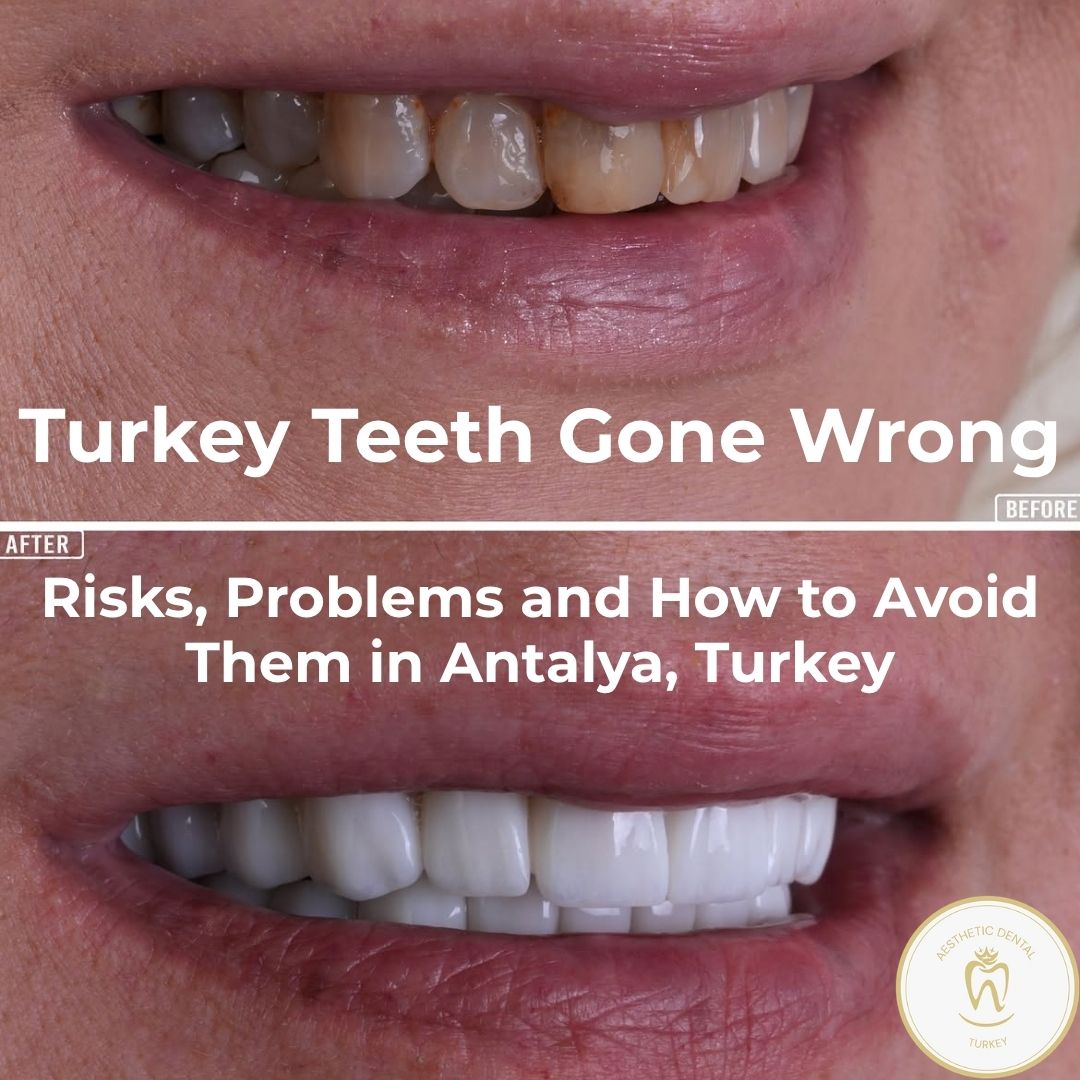
Search for "Turkey teeth" online and you'll see two very different pictures.
One is the dramatic smile transformation: straight, bright teeth completed during a trip to Turkey. The other is less appealing. Videos and news stories show people dealing with pain, bulky crowns, sore gums or dental work that needs to be replaced once they get home.
The reality isn't quite as simple as either version.
People travel from the UK and other European countries to Antalya, Turkey for all kinds of dental treatment. Cost is obviously part of the attraction, but so are shorter waiting times and access to clinics that regularly work with international patients.
And despite the name, there is no dental treatment called "Turkey teeth." It's a popular expression that has come to cover everything from veneers and crowns to implants and complete smile makeovers.
So what actually causes a smile makeover to go wrong? Usually, it's not where the dentistry was done. What matters far more is whether the right treatment was chosen in the first place, how carefully it was planned and carried out, and what happens afterwards.
Let's look at where the problems can start.
What Does "Turkey Teeth" Actually Mean?
Are Turkey teeth veneers or crowns?
This is where a lot of the confusion begins.
Some people use "Turkey teeth" to describe veneers. Others are actually talking about crowns. They're not the same thing.
A veneer is a thin restoration placed over the front of a tooth. A crown wraps around much more of it. Then there are patients who have implants for missing teeth, or a combination of treatments across the same smile.
That distinction matters. The amount of natural tooth that needs to be altered can be very different depending on what you're having done.
Why has the term "Turkey teeth" become so popular?
Social media has played a big part.
Smile makeovers are easy before-and-after content, and the phrase "Turkey teeth" quickly became attached to the bright, uniform smiles appearing on TikTok, Instagram and reality TV.
It didn't stay neutral for long. The same phrase also started appearing alongside stories about teeth being filed down, unnatural-looking crowns and patients returning home with dental problems.
Those cases shouldn't be dismissed. But they shouldn't be taken to mean that every patient treated in Turkey receives the same treatment either.
Why do patients travel to Antalya, Turkey for dental treatment?
Price is certainly one reason. Private dental work can be expensive in the UK and elsewhere in Europe, particularly when several teeth are involved.
But there are other reasons too. Antalya has many clinics accustomed to overseas patients, treatment can often be organised without long waiting lists, and some people like being able to combine their dental visit with time away.
Still, location and price shouldn't decide what happens to your teeth. The treatment has to make sense clinically first.
Why Do Some Turkey Teeth Go Wrong?
There's rarely one simple explanation.
Problems can begin with the initial treatment decision, during tooth preparation or when the final restorations are fitted. Sometimes the dental work itself is fine, but an issue develops later and isn't followed up.
Here are some of the more common ways things can go off track.
Poor treatment planning
A smile makeover needs more than photographs.
The dentist needs to know what's happening beneath the surface too. That may mean X-rays, checking the gums, looking for decay or old dental work, and seeing how the upper and lower teeth meet.
If those checks are skipped, an attractive new crown can end up covering a tooth that already had an unresolved problem.
Removing too much healthy tooth structure
This is probably the image most closely associated with "Turkey teeth gone wrong": natural teeth reduced much more than the patient expected.
Some tooth preparation is necessary for many restorations. The important question is whether the amount removed is appropriate for that particular tooth and treatment.
A badly damaged tooth may genuinely benefit from a crown. A healthy tooth being changed mainly for cosmetic reasons may have more conservative possibilities.
Once natural tooth tissue has been removed, you can't put it back. That's why this decision matters.
Poorly fitting veneers or crowns
The edge of a restoration is easy to overlook because it isn't the part you notice in a smile photograph.
Dentally, though, it's important.
If a veneer or crown doesn't meet the tooth properly, the area can become difficult to clean. Plaque may collect around the margin and the surrounding gum can become irritated. Problems underneath the restoration can also be harder to spot.
Bite and occlusion problems
A smile can look excellent in a photograph and still feel wrong when you eat.
After crowns or veneers are fitted, the dentist needs to check how the teeth meet. If one area is taking more pressure than it should, you may notice discomfort, chipping or the feeling that your bite has changed.
Appearance is only half the job. Your new teeth still have to function as teeth.
Inadequate oral hygiene and aftercare
Finishing treatment isn't the end of the story.
Crowns and veneers still need daily care, and the teeth and gums around them need regular checks. This becomes especially important for patients who have travelled abroad, because their treating dentist may be hundreds or thousands of miles away once they return home.
Before leaving Antalya, you should know what to do if something doesn't feel right later.
And it's worth repeating: none of these issues belongs exclusively to Turkey. Poorly planned or poorly maintained dentistry can fail anywhere.
Do Turkey Teeth Ruin Your Natural Teeth?
They don't automatically ruin your teeth.
What is true is that some cosmetic dental treatments involve permanently changing the natural tooth. Patients should understand that before treatment begins.
Does getting veneers damage your teeth?
It depends on the veneer and the tooth.
Porcelain and E-max veneers may require enamel preparation so that the final restoration sits naturally rather than looking bulky. How much preparation is needed varies from case to case.
The important point is to avoid removing more healthy structure than the treatment actually requires.
We've looked at this question in more detail in Do Veneers Ruin Your Teeth?
How much tooth is removed for dental crowns?
Usually more than for a veneer.
That's because a crown surrounds the tooth rather than covering mainly its front surface. The dentist needs enough space for the restorative material while also creating a shape that allows the crown to fit securely.
Exactly how much preparation is necessary depends on the starting condition of the tooth and the restoration being used.
Is tooth preparation permanent?
Yes.
Natural enamel doesn't regenerate after it has been removed. A tooth that has been prepared for a veneer or crown will therefore continue to need a restoration.
It's one reason patients should know exactly what they're agreeing to before treatment starts.
Veneers vs Crowns: Why the Difference Matters
The words sometimes get used interchangeably online, but clinically they're very different.
What are dental veneers?
A veneer covers the visible front surface of a tooth. Porcelain and E-max are commonly used when the goal is to alter things such as colour, proportion, shape or small spaces between teeth.
Because a veneer doesn't wrap around the whole tooth, it can often be a more conservative approach than a crown.
More information is available on our porcelain veneers and E-max veneers pages.
What are dental crowns?
A crown covers the tooth much more extensively.
That can be useful when a tooth has lost a significant amount of structure, contains a large filling, has been root-treated or needs additional protection.
Zirconium crowns, for example, are used in both restorative and aesthetic dentistry.
When might a dentist recommend veneers instead of crowns?
If a tooth is healthy and the concern is mainly cosmetic, a veneer may sometimes achieve the desired change without preparing the tooth for a full crown.
But veneers aren't automatically the answer either.
Depending on what bothers you about your smile, whitening, orthodontics or composite bonding could also be worth discussing.
The sensible approach is to start with the problem you're trying to solve rather than deciding on a restoration before the dentist has examined your teeth.
Why should healthy teeth not be unnecessarily reduced?
Because keeping natural tooth structure gives you more to work with in the future.
A crown or veneer may eventually need repair or replacement. Preserving healthy enamel and dentine where possible can make future treatment less complicated.
What Happens If Too Much Tooth Enamel Is Removed?
Taking away more tooth structure than necessary can create problems, particularly if the preparation reaches deeper into the tooth.
Increased tooth sensitivity
Enamel protects the more sensitive dentine underneath.
Once more dentine is exposed or sits closer to the restoration, a tooth may react more strongly to temperature changes or certain foods.
Some sensitivity after treatment can settle. Persistent or increasing sensitivity deserves another look.
Risk of pulp irritation
Deep inside each tooth is the pulp, which contains nerves and blood vessels.
Dental preparation can irritate this tissue, especially when treatment is extensive. Often the tooth settles afterwards. Occasionally, inflammation continues instead.
When might root canal treatment be needed?
If the pulp is unable to recover or becomes infected, root canal treatment may be recommended in an attempt to keep the tooth.
This doesn't mean that a crown automatically leads to a root canal. It doesn't. The condition of the tooth before treatment and the extent of the dental work both matter.
What Are the Common Signs of Turkey Teeth Gone Wrong?
A new smile can take a little getting used to, so not every unfamiliar sensation means something has failed.
There are, however, symptoms you shouldn't simply ignore:
- Pain or sensitivity that persists or becomes worse, particularly pain that disturbs your sleep.
- Gums that remain swollen, bleed easily or begin to recede around the restorations.
- Crowns or veneers that feel loose or have edges that are difficult to clean.
- A bite that feels noticeably different, especially if chewing becomes uncomfortable.
- Persistent bad breath or an unusual taste despite normal brushing and cleaning.
- A restoration that cracks, chips or changes appearance.
If something doesn't feel right, having it checked early is usually easier than waiting for it to become a bigger problem.
Is Tooth Sensitivity Normal After Getting Turkey Teeth?
How long can sensitivity last after veneers or crowns?
A newly treated tooth can be sensitive for a while.
It has just been prepared and restored, so reactions to cold or heat aren't necessarily surprising at first. In many cases this becomes less noticeable as the tooth settles.
There's no useful reason to tough out sensitivity that's getting worse, though.
When should tooth sensitivity be checked by a dentist?
Pay particular attention if the discomfort starts increasing rather than decreasing, stays for a long time after something hot or cold, becomes a spontaneous ache, or is accompanied by swelling.
Those symptoms deserve a dental assessment.
Can Turkey Teeth Cause Gum Problems?
Crowns and veneers sit right next to the gums, so their shape and fit can influence how easy that area is to keep clean.
Why can gums become red or swollen after treatment?
The gums may be temporarily irritated after dental work. They have often been manipulated while impressions, scans, temporary restorations or final restorations were being placed.
That should improve as the tissues recover.
Redness or bleeding that continues, rather than gradually settling, is different and should be investigated.
Can poorly fitting crowns affect gum health?
They can.
An awkward margin can create a spot where plaque repeatedly collects. If that area is difficult to reach with a toothbrush or floss, inflammation can persist.
The problem isn't simply how the crown looks. Its relationship with the tooth and gum matters too.
How can you keep your gums healthy after treatment?
Treat restored teeth much like natural teeth.
Brush carefully twice a day and clean the spaces between the teeth. Keep regular dental and hygiene appointments as well.
The porcelain or zirconia itself won't develop tooth decay, but the natural tooth beneath or beside it is still vulnerable.
Can Turkey Teeth Lead to Root Canal Treatment?
Why might a tooth need root canal treatment after a crown?
Sometimes the nerve inside a tooth was already compromised before the crown was fitted. Deep decay, large old fillings, cracks or previous dental work can all play a role.
In other cases, extensive preparation may contribute to irritation of the pulp.
That's why assessing the tooth before cosmetic work begins is so important.
Does every crowned tooth need a root canal?
No.
Root canal treatment isn't a routine requirement simply because a tooth has been crowned. It becomes relevant when the pulp is irreversibly inflamed or infected.
What Should You Do If Your Turkey Teeth Go Wrong?
First, don't try to diagnose the problem from photographs or social media posts.
Several different dental problems can produce similar symptoms.
Contact your treating dentist
Tell the clinic exactly what has happened and when the symptoms began.
Photographs may help them understand what you're describing, but they don't replace an examination. Ask what they recommend and what their aftercare policy covers.
Get a second dental opinion
If you're already back home, you don't have to wait until you can travel again to have the problem assessed.
A local dentist can examine the teeth, take X-rays where needed and give you another view of what's happening.
This is particularly sensible if you're in pain.
Ask for X-rays and your treatment records
Keep copies of your dental records.
Knowing which teeth were treated, what materials were used and what the X-rays looked like can save time if another dentist needs to take over your care.
When should you seek urgent dental care?
Facial swelling, fever or severe uncontrolled pain requires urgent dental assessment where you are. Do not wait for your next trip to Antalya.
If you have difficulty breathing or swallowing, go to the nearest emergency department immediately or call the local emergency number. See the NHS guidance on dental abscesses.
Can Bad Turkey Teeth Be Fixed?
Often they can, but the solution depends on what's actually wrong.
A cosmetic problem and an infected tooth, for example, need very different treatment.
Replacing poorly fitting veneers or crowns
If the underlying tooth is healthy enough, an unsuitable restoration may be removed and replaced.
Before doing that, the dentist needs to understand why the first one failed. Simply making another crown without addressing the cause may recreate the same problem.
Treating gum problems
Sometimes the answer is relatively straightforward: professional cleaning, better home care and time for the gums to recover.
If the restoration itself is contributing to the inflammation, however, it may also need to be corrected or replaced.
Root canal treatment when necessary
When the pulp of a tooth has been irreversibly damaged, root canal treatment may allow the tooth to remain in place.
The restoration may then need further work depending on its condition.
Dental implants for teeth that cannot be saved
Not every tooth can be predictably restored.
When extraction becomes necessary, a dental implant is one possible replacement. A bridge or removable option may be appropriate in other situations.
Our guide to dental implants vs bridges looks at those choices in more detail.
How Much Does It Cost to Fix Turkey Teeth?
There's no useful one-price answer to this question.
Someone who needs one crown replaced is in a very different situation from someone who needs several restorations removed, root canal treatment and new dental work.
What determines the cost of corrective dental treatment?
The dentist first needs to find out what can be kept.
From there, cost depends on the number of affected teeth, the condition of those teeth, whether existing restorations can remain, and whether additional treatment is needed before anything new is fitted.
Materials and the complexity of the case matter as well.
Is it better to return to Turkey or see a dentist at home?
That depends partly on how urgent the problem is.
If you have significant pain, swelling or signs of infection, don't delay treatment because you're planning to return to Turkey.
For non-urgent corrective work, you may want to speak both to the original clinic and to a dentist at home before deciding what to do.
Can a dentist give a price before examining your teeth?
Photos and X-rays can be useful for an initial discussion.
But corrective dentistry can reveal problems that aren't obvious in a photograph. A final treatment plan and reliable cost normally require a proper examination.
How Can You Avoid Turkey Teeth Going Wrong?
No clinic can promise that dental treatment will never develop a problem.
You can, however, ask better questions before anyone starts preparing your teeth.
Have a full dental examination before treatment
Don't confuse an online quote with a diagnosis.
Photos can help a clinic understand what you're looking for. They can't show everything a dentist needs to know about the health of your teeth, roots, gums and bite.
The final decision should come after an appropriate clinical assessment.
Understand whether you need veneers or crowns
Ask why a particular restoration has been recommended.
If the dentist suggests a crown, find out what makes a crown preferable for that tooth. If you're being offered veneers, ask how much preparation they expect to do.
A good consultation should leave you understanding the reasoning, not just the price.
Avoid choosing a clinic based on price alone
It's reasonable to compare prices. Most people do.
Just compare like with like.
Look at what the proposed treatment actually includes, which materials are being used, who is carrying out the dentistry and what happens if you need help once you're home.
A cheap quote isn't much of a saving if the wrong treatment has been chosen.
Ask to see your treatment plan before starting
You should know which teeth are being treated and what is planned for each one.
For aesthetic cases, a mock-up or digital preview may also help you discuss shape, proportion and shade before the final restorations are made.
Don't be afraid to ask questions before an irreversible step.
Understand the aftercare and guarantee policy
This is particularly important when you're travelling for treatment.
Ask what the clinic expects you to do after treatment, what its guarantee actually covers, whether routine check-ups are required, and what happens if you have a problem after returning home.
How to Choose a Dental Clinic in Antalya, Turkey
There are plenty of dental clinics in Antalya, and their websites can start to look very similar after a while.
Look beyond the package price.
Check the dentist's qualifications and experience
Find out who the dentists are rather than looking only at the clinic brand.
Experience relevant to the treatment you're considering matters. Implant surgery and cosmetic veneers, for instance, involve different skills and planning.
Before-and-after photographs can be useful too, particularly when you're looking at cases similar to your own.
Ask who will actually perform your treatment
The person answering your first message may not be your dentist.
Before booking, ask who will carry out the clinical work and whether you'll have an opportunity to discuss the plan directly with them.
Check what diagnostic tests are included
Ask what examinations and imaging will be needed before treatment begins.
The answer will vary with the procedure. Implant planning, for example, may require different imaging from a straightforward cosmetic case.
What matters is that diagnosis comes before irreversible treatment.
Ask about materials and dental laboratories
You don't need to become an expert in dental ceramics before travelling.
You should still be able to ask what material is being recommended, why it suits your case and where the restorations are being made.
Understand follow-up care before returning home
Some dental treatments can be completed during one trip; others need separate stages or return visits.
Find out how long your own treatment is expected to take rather than relying on a general package timetable.
Also ask what support is available once you've left Turkey.
Our guide to how to get your teeth done in Antalya, Turkey explains the process in more detail.
Questions to Ask Your Dentist Before Getting Turkey Teeth
You don't need a long list of technical dental questions. Start with the things that directly affect your teeth:
- Do I need veneers or crowns, and why?
- How much of my natural tooth will need to be prepared?
- Are there more conservative alternatives for any of these teeth?
- Is there anything on my X-rays that needs treatment first?
- Which materials are you recommending?
- Who will actually carry out my treatment?
- How will you check my bite before I leave?
- How long should I stay in Antalya?
- What happens if I have a problem after I return home?
- Can I have copies of my X-rays and treatment records?
You should come away from the consultation knowing what is going to happen to your teeth and why.
Getting Turkey Teeth Safely in Antalya, Turkey
A successful smile makeover shouldn't be defined by how white the teeth are.
It should fit the person.
That means considering tooth shape and proportion, but also the gums, bite and health of the natural teeth underneath. Sometimes the right answer is veneers. Another patient may genuinely need crowns. Someone else may be better served by whitening, orthodontics or a combination of treatments.
At Aesthetic Dental Turkey, treatment planning begins by looking at the condition of the teeth, gums and bite. The aim is to choose an appropriate option for each tooth and preserve healthy tooth structure where the clinical situation allows.
If you're considering Turkey teeth in Antalya, Turkey, the useful question isn't simply, "How many veneers or crowns can I get?"
It's, "What does each of my teeth actually need?"
If you'd like to discuss your options, get in touch with our team. Photos and recent X-rays can help with the initial conversation, followed by a clinical assessment before final treatment decisions are made.
Frequently Asked Questions About Turkey Teeth
Are Turkey teeth safe?
"Turkey teeth" isn't a specific procedure, so there's no single answer that applies to everyone. Dental treatment in Turkey, as elsewhere, depends on appropriate diagnosis, treatment planning, the dentist carrying out the work and the patient's individual oral health. Before agreeing to treatment, make sure you understand exactly what is being proposed.
Do Turkey teeth ruin your natural teeth?
Not automatically. The effect on a natural tooth depends largely on the treatment being performed. Veneers may involve relatively limited preparation in suitable cases, whereas crowns generally require more of the tooth to be reshaped. Any irreversible preparation should have a clear clinical or aesthetic reason.
What are the most common Turkey teeth problems?
Problems patients may experience include ongoing sensitivity or pain, irritated gums, difficulty cleaning around restorations, an uncomfortable bite, loose restorations, chipping or a result that doesn't look as expected. The cause needs to be assessed rather than assumed from the symptom alone.
Are Turkey teeth veneers or crowns?
They may be veneers, crowns or a mixture of different treatments. "Turkey teeth" is an informal expression rather than the name of a dental procedure. Always ask the clinic what treatment is actually being proposed for each tooth.
Why do some Turkey teeth look too big or unnatural?
Several things can affect the final appearance, including tooth proportions, restoration thickness, shade, gum position and how the new teeth relate to the lips and face. Discussing the intended shape and shade before the final restorations are made can help avoid surprises.
Is it normal for Turkey teeth to hurt after treatment?
A degree of sensitivity can occur after dental treatment, particularly when teeth have been prepared. What matters is how the symptoms develop. Pain that is severe, persists, gets worse or occurs with swelling should be assessed by a dentist.
Can Turkey teeth cause gum problems?
Gum problems can develop around any restoration if plaque is difficult to remove or if the relationship between the restoration, tooth and gum isn't ideal. Good fit, daily cleaning and regular dental care all matter.
Can crowns in Turkey lead to root canal treatment?
A tooth doesn't need root canal treatment simply because it receives a crown. Root canal treatment may become necessary if the pulp inside the tooth becomes irreversibly inflamed or infected. Existing tooth damage and the amount of treatment required can influence that risk.
Can Turkey teeth be fixed if something goes wrong?
Many problems can be treated, but the solution depends on the cause and the amount of healthy tooth remaining. Treatment might involve adjusting or replacing a restoration, treating the gums, carrying out root canal treatment or considering replacement options if a tooth cannot be kept.
How long do Turkey teeth last?
There isn't one lifespan for "Turkey teeth" because the term covers different restorations. Material, bite, oral hygiene, tooth grinding and maintenance can all influence longevity. You can find more detail in our guides to how long veneers last and how long zirconium crowns last.
How much does it cost to fix Turkey teeth?
It depends on what needs correcting. Replacing one restoration isn't comparable with treating several teeth that also need root canal or gum treatment. Photos and X-rays may help with an initial estimate, but an examination is usually needed before a final treatment plan and price can be given.
How can I choose a safe dental clinic in Antalya, Turkey?
Look beyond price and before-and-after photographs. Find out who will treat you, what examination is carried out before treatment, why each procedure is being recommended, which materials will be used and what support is available after you return home. You should have enough information to understand the treatment before making a decision.
Written by Dr. Ahmet ALP
Medically reviewed by Dr. Ahmet Alp
Oral and Maxillofacial Surgeon
Last medically reviewed: